
Legal Entity Identifier Number Registration
Legal Entity Identifier Number Registration
A Legal Entity Identifier (LEI) is a unique 20-character alphanumeric code assigned to organizations involved in financial transactions.The LEI system helps regulators, banks, and financial institutions identify legal entities accurately and improve transparency in financial markets.
In India, the Reserve Bank of India (RBI) has made LEI registration mandatory for specific financial transactions, including high-value payments, derivative contracts, and certain foreign exchange transactions. TaxAbide provides complete assistance for LEI registration, renewal, and compliance support to businesses across India.
The LEI framework was developed to improve transparency and reduce risks within the international financial system. Every LEI is linked to verified information about the entity, making it easier for regulators and financial institutions to identify participants in financial transactions. The LEI system is governed internationally under the Global Legal Entity Identifier Foundation and follows the ISO 17442 standard.

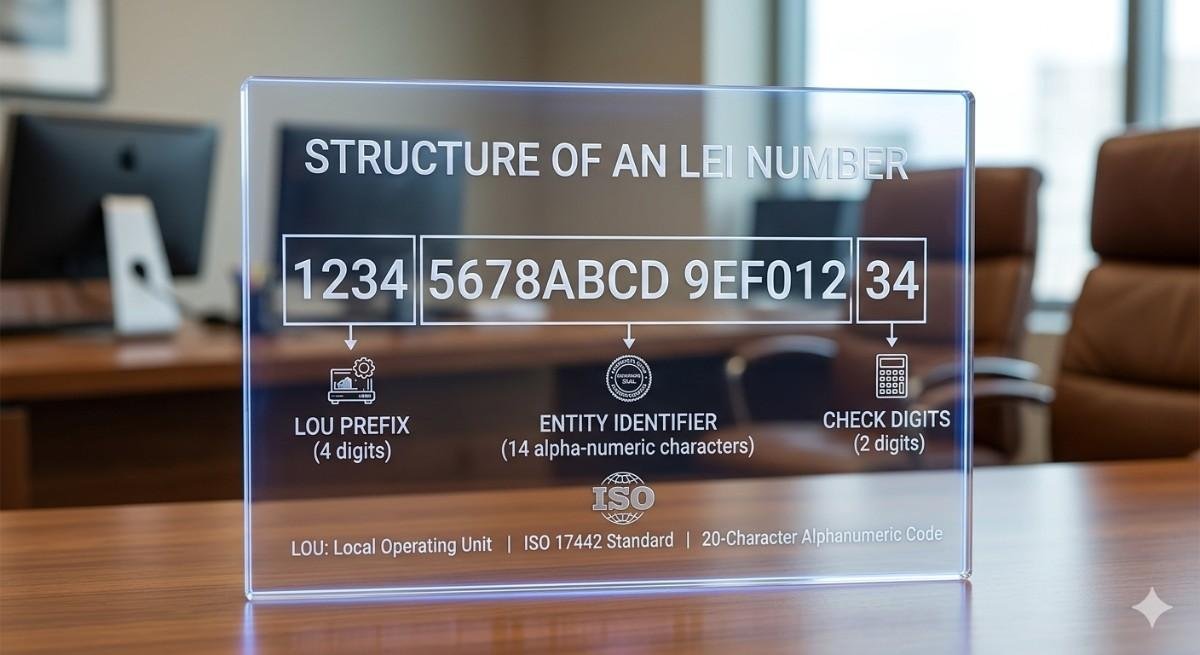
Structure of an LEI Number
- An LEI consists of 20 alphanumeric characters.
- The code is divided into different sections.
- Characters 1 to 4 identify the issuing organization.
- Characters 5 to 18 represent the unique identity of the legal entity.
- Characters 19 and 20 are verification digits used for validation purposes.
- This standardized format ensures that every LEI remains unique across the world.
LEI Number vs Other Business Identifiers
Compare the purpose and scope of major business identification systems.
LEI Number
Financial transaction identification
Global ScopePAN
Tax identification
IndiaCIN
Company identification
IndiaGSTIN
GST compliance and taxation
IndiaDUNS Number
Business credit identification
Global ScopeWhy is LEI Registration Important in India?
The RBI introduced LEI requirements to improve transparency in the financial ecosystem.
The objective is to enhance risk management and accurately identify entities participating in large-value transactions.
Businesses that fail to comply with LEI requirements may face transaction restrictions, compliance issues, and delays in financial dealings.
Obtaining an LEI helps organizations meet regulatory requirements while ensuring uninterrupted financial operations.
RBI Requirements for LEI Compliance
The RBI has mandated LEI registration for various financial activities.
These include:
Large-value RTGS and NEFT transactions.
Over-the-counter derivative contracts.
Money market transactions.
Government securities market transactions.
Specified foreign exchange transactions.
Cross-border financial dealings involving eligible entities.
Who Should Obtain an LEI Number?
The following entities may be required to obtain an LEI:
Private Limited Companies.
Public Limited Companies.
Limited Liability Partnerships.
Partnership Firms.
Banks.
NBFCs.
Insurance Companies.
Mutual Funds.
Trusts and Societies.
Government Organizations.
Foreign entities participating in Indian financial markets.
Objectives of LEI Registration
The primary purpose of LEI registration is to establish a standardized global identification system for legal entities.
The LEI framework helps:
Improve transparency.
Reduce financial risks.
Enhance regulatory reporting.
Strengthen anti-money laundering measures.
Support effective KYC processes.
Facilitate cross-border business transactions.
Benefits of LEI Registration
Benefits for Businesses
Global business recognition.
Improved credibility with banks and financial institutions.
Faster processing of financial transactions.
Better compliance with RBI regulations.
Enhanced risk management capabilities.
Access to international financial markets.
Benefits for Financial Institutions
Accurate identification of counterparties.
Simplified compliance reporting.
Reduced operational risks.
Greater transparency in transactions.
Improved monitoring of financial activities.
Eligible Entities for LEI Registration
Various legal entities can apply for an LEI.
Private Limited Companies.
Public Limited Companies.
One Person Companies.
LLPs.
Partnership Firms.
Sole Proprietorships.
Trusts.
Societies.
Producer Companies.
Subsidiaries of foreign companies.
Banks and financial institutions.
Government departments and public sector entities.
Information Required for LEI Registration
Before applying, businesses should keep the following information ready:
Legal name of the entity.
Registered office address.
Country of registration.
Business registration details.
Entity type.
PAN details.
Corporate structure information.
Parent company details, if applicable.
Authorized signatory information.
Contact details.
Documents Required for LEI Registration
Private Limited and Public Limited Companies
Certificate of Incorporation.
PAN Card.
MOA and AOA.
GST Registration Certificate.
Latest audited financial statements.
LLPs
Certificate of Incorporation.
LLP Agreement.
PAN Card.
GST Certificate.
Partnership Firms
Partnership Deed.
PAN Card.
GST Registration.
Address Proof.
Sole Proprietorships
PAN Card.
GST Registration.
Business Registration Proof.
Address Proof.
Trusts and Societies
Registration Certificate.
Trust Deed or Memorandum.
PAN Card.
Address Proof.
Foreign Entities
Certificate of Incorporation.
Notarized supporting documents.
PAN, if applicable.
How to Obtain an LEI Number in India?
Entities can obtain an LEI through accredited organizations authorized to issue LEIs.
In India, the LEI registration process is managed through recognized issuing authorities that verify entity information before assigning an LEI.
Professional assistance can help reduce delays and ensure accurate submission of documents.
LEI Registration Process
Step 1 – Create an account on the LEI registration platform.
Step 2 – Select the correct entity type.
Step 3 – Complete the application form with entity details.
Step 4 – Upload the required documents.
Step 5 – Pay the applicable registration fee.
Step 6 – Submit the application for verification.
Step 7 – Await document review and approval.
Step 8 – Receive the LEI number after successful verification.
Online LEI Registration Process
The entire registration process can be completed online.
Applicants can submit details, upload documents, make payments, and track application status digitally.
This makes the process convenient and time-efficient for businesses across India.
Common Mistakes to Avoid
Entering an incorrect legal entity name.
Providing the wrong registered address.
Uploading incomplete documents.
Using incorrect PAN information.
Missing parent company information.
Submitting expired documents.
Carefully reviewing the application before submission helps avoid rejection and delays.
LEI Registration Fees
LEI registration fees vary depending on the issuing authority and service provider.
Charges generally include:
New LEI Registration.
Annual LEI Renewal.
LEI Transfer Requests.
Entity Information Updates.
Contact TaxAbide for the latest pricing and assistance.
LEI Validity and Renewal
An LEI remains valid for one year from the date of issuance.
Organizations must renew their LEI annually to maintain active status.
Timely renewal ensures uninterrupted compliance and prevents transaction restrictions.
LEI Renewal Process
Verify existing information.
Update any changed details.
Upload revised documents if required.
Pay renewal fees.
Submit the renewal request.
Receive confirmation after approval.
Consequences of Not Renewing an LEI
LEI status may become inactive.
Financial transactions may be rejected.
Regulatory compliance issues may arise.
Cross-border transactions can be disrupted.
Participation in certain financial markets may become restricted.
How to Download an LEI Certificate?
After approval, applicants can download their LEI certificate from the registration portal.
The certificate contains:
LEI Number.
Entity Name.
Registration Information.
Issuing Authority Details.
Validity Period.
The certificate should be securely stored for future compliance purposes.
How to Verify an LEI Number?
LEI verification can be completed through official LEI search platforms.
Verification helps confirm:
Entity identity.
Current LEI status.
Registration details.
Renewal information.
Corporate ownership information.
This allows banks, regulators, and business partners to validate the authenticity of an LEI before conducting transactions.
Why Choose TaxAbide for LEI Registration?
TaxAbide offers end-to-end support for LEI registration and renewal.
Our experts assist with documentation, application filing, compliance checks, and renewal management.
We help businesses complete the process accurately and efficiently while ensuring compliance with applicable regulations.
Whether you need a new LEI registration or annual renewal, TaxAbide provides professional assistance every step of the way.