

GSTR-10 Filing
GSTR-10 Filing
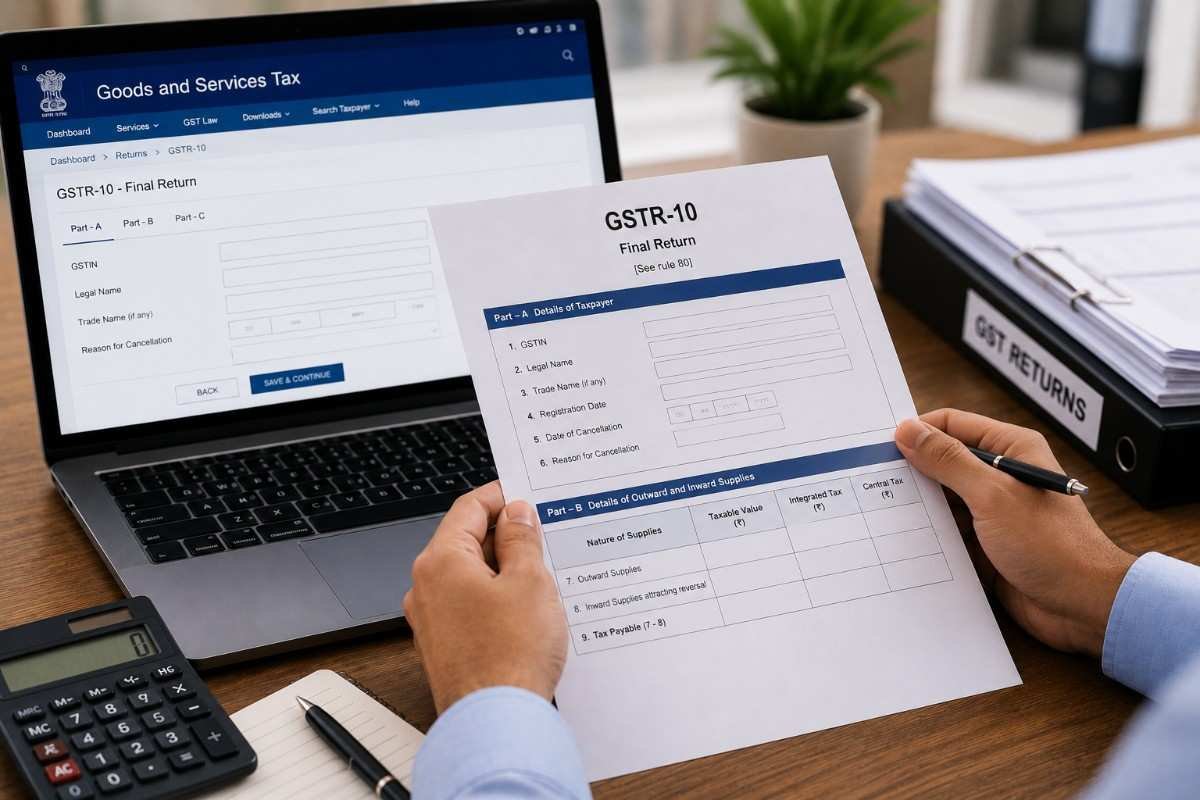
When a business decides to discontinue operations or its GST registration is cancelled by the tax authorities, certain compliance requirements must still be completed. One of the most important obligations is filing the GSTR-10 Final Return.
GSTR-10 is a special return that must be submitted after the cancellation of GST registration. This return helps the government verify that all tax liabilities have been cleared and that any input tax credit associated with remaining stock has been properly accounted for.
Failure to submit the return within the prescribed timeline may result in late fees and compliance notices from the GST department.
The objective of the return is to ensure that all GST obligations are settled before the taxpayer exits the GST system.
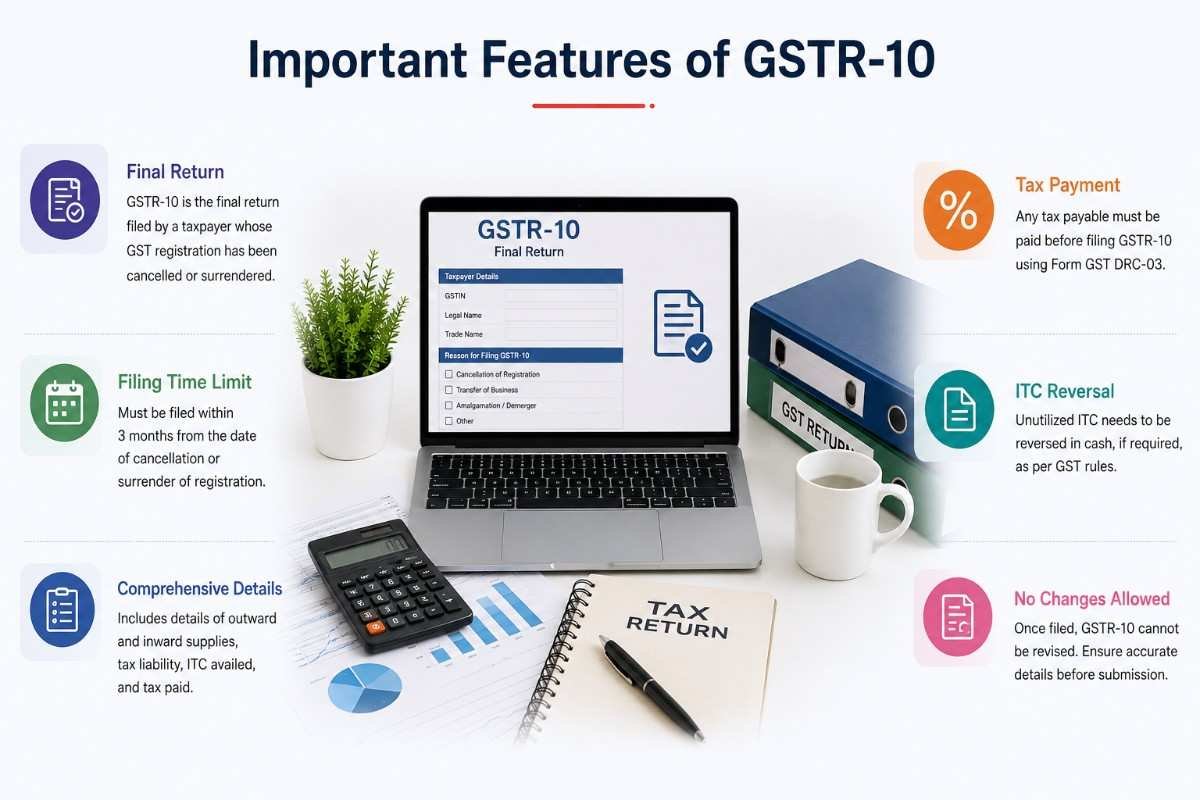
Important Features of GSTR-10
Before filing the return, every taxpayer should understand the key points associated with GSTR-10:
- Governed by Section 45 of the CGST Act and Rule 81 of the CGST Rules.
- Applicable only after GST registration cancellation.
- Filed only once and not on a recurring basis.
- Requires reporting of stock held on the cancellation date.
- Input Tax Credit on remaining stock may need to be reversed.
- Tax liability must be discharged before final closure.
- Filing must be completed within the prescribed time limit.
- Submission is done electronically through the GST portal.
Who Must File GSTR-10?
The requirement to file GSTR-10 depends on the category of taxpayer.
Taxpayers Required to File
Regular GST registered businesses whose registration has been cancelled by the department.
Businesses that voluntarily applied for GST cancellation.
Proprietorships, partnerships, LLPs, and companies that have closed their GST registration.
Taxpayers Not Required to File
The following categories are generally exempt from filing GSTR-10:
Composition taxpayers.
Input Service Distributors.
Non-resident taxable persons.
Persons deducting tax under TDS provisions.
Persons collecting tax under TCS provisions.
Due Date for Filing GSTR-10
The final return must be filed within three months from:
The date of the GST cancellation order, or
The effective date of cancellation,
whichever occurs later.
Timely filing is important because delayed submission attracts late fees that continue to accumulate until the return is filed.
From time to time, the government may announce relief measures or amnesty schemes that reduce the burden of late fees for taxpayers with pending returns.
Documents Required for GSTR-10 Filing
To ensure accurate filing, keep the following documents and information ready:
GST cancellation order.
Details of stock held on the cancellation date.
Information about raw materials, semi-finished goods, and finished goods.
Details of capital goods available at the time of cancellation.
Input tax credit records.
Previously filed GST returns.
Tax payment details, if applicable.
PAN details of the business.
Aadhaar details of the authorized signatory.
Digital Signature Certificate or Electronic Verification Code credentials.
Step-by-Step Process to File GSTR-10 Online
Step 1: Access the GST Portal
Visit the GST portal and log in using your GST credentials.
Step 2: Open Final Return Section
Navigate to the Returns section and select the option for Final Return filing.
Step 3: Review Basic Information
Verify details such as GSTIN, business name, trade name, and cancellation information displayed by the system.
Step 4: Enter Stock Information
Provide details of all stock available immediately before the effective cancellation date.
Step 5: Verify ITC Liability
The system calculates the amount of input tax credit that may need to be reversed. Carefully review the figures.
Step 6: Make Tax Payment
If any tax liability arises, generate a challan and complete the payment through the GST portal.
Step 7: Upload Supporting Details
Attach required information and supporting records wherever applicable.
Step 8: Preview the Return
Review all entries before submission to avoid mistakes.
Step 9: Submit and Verify
File the return using a Digital Signature Certificate or Electronic Verification Code.
Step 10: Save the Acknowledgement
After successful submission, an Application Reference Number is generated. Keep this acknowledgement for future reference.
Late Fee for Delayed Filing
Businesses that fail to submit GSTR-10 within the due date may be required to pay a late fee.
Standard Late Fee Structure
CGST Late Fee: ₹100 per day.
SGST or UTGST Late Fee: ₹100 per day.
Total Late Fee: ₹200 per day.
The late fee continues to accumulate until the return is filed, subject to applicable government notifications and relief schemes.
In addition to monetary penalties, taxpayers may also receive notices from the GST department for non-compliance.
What Happens After Filing GSTR-10?
Once the return is successfully filed and accepted:
GST Registration Closure
The GST registration is permanently marked as cancelled.
No further GST returns are required for that GSTIN.
The cancellation status can be verified on the GST portal.
Record Maintenance
Businesses should preserve GST records and supporting documents for the period prescribed under GST law.
Future Business Activities
If the business starts operations again in the future, a fresh GST registration may be required.
Before filing GSTR-10, businesses should also ensure that any pending refunds, export-related compliances, or other GST obligations have been properly addressed.
Why Choose TaxAbide for GSTR-10 Filing?
TaxAbide provides professional support for GSTR-10 Final Return filing across India. Our experts help businesses complete the filing process accurately and within the prescribed timelines.
Our services include:
Review of GST cancellation requirements.
Verification of stock and ITC details.
Preparation and filing of GSTR-10.
Assistance with tax liability calculation.
Support for notices and compliance issues.
End-to-end guidance until successful filing.
With TaxAbide, you can complete your GST closure process smoothly while minimizing the risk of penalties, errors, and compliance delays.