
GST E-Invoicing for RCM 2027: New Self-Invoice Rules, RCMDOM & RCMIMP Explained
Published: November 25, 2026
Last Updated: November 25, 2026
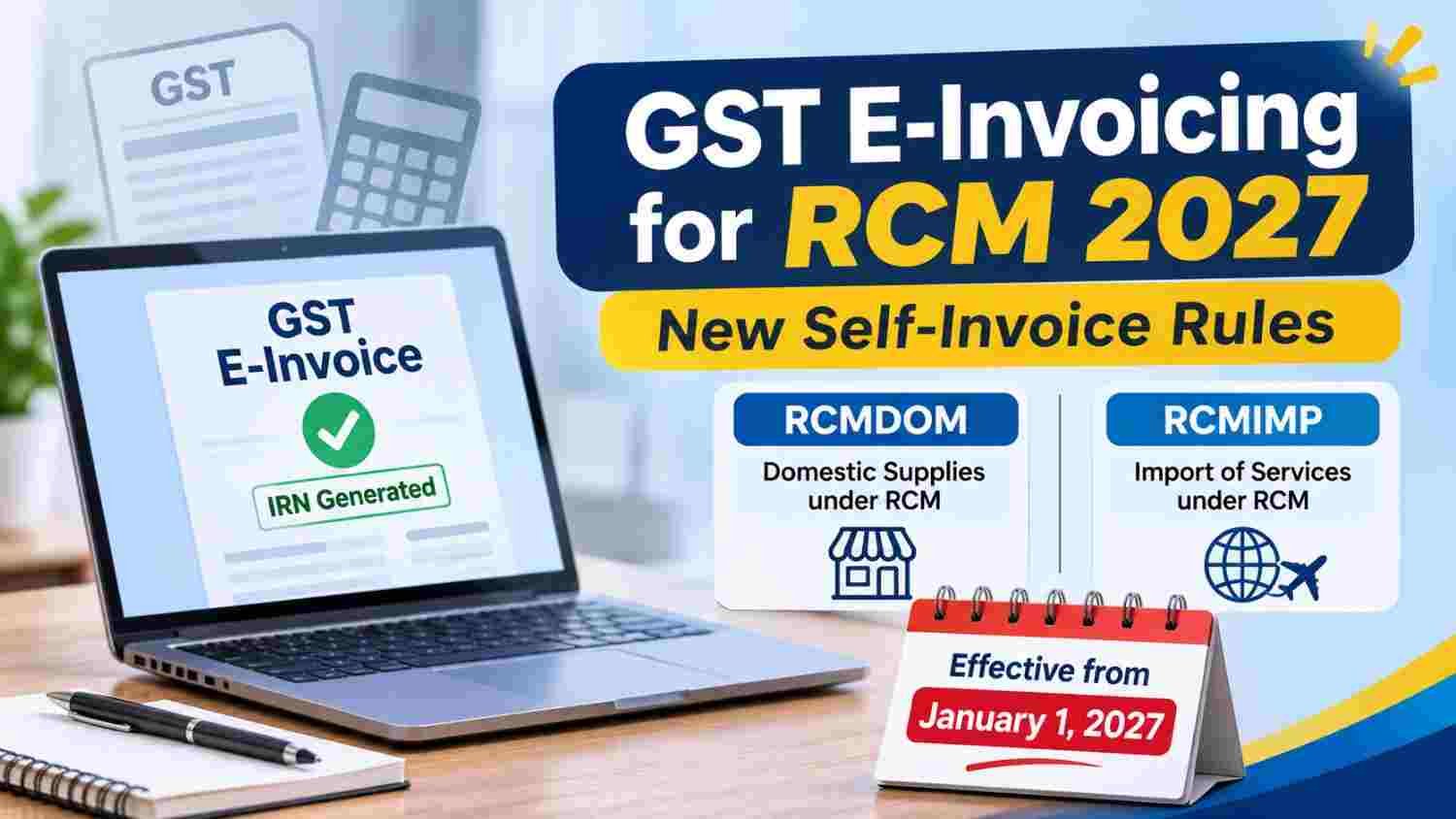
GST E-Invoicing for RCM 2027 is an important compliance update for businesses receiving certain supplies under the Reverse Charge Mechanism (RCM). From January 1, 2027, the e-invoicing framework will also cover specified domestic supplies received from unregistered persons where the recipient pays GST under RCM and imports of services.
The Government introduced this change through Notification No. 04/2026–Central Tax dated October 26, 2026. Additionally, Notification No. 05/2026–Central Tax provides related amendments to the CGST Rules and e-invoice schema.
These changes introduce two new supply categories: RCMDOM and RCMIMP. Therefore, eligible businesses should review their self-invoicing procedures, accounting software, and ERP integrations before implementation.
Quick Answer: What Are the New GST E-Invoicing Rules for RCM in 2027?
From January 1, 2027, e-invoicing will extend to two additional categories:
RCMDOM: Specified domestic supplies received from unregistered persons where the recipient is liable to pay GST under RCM.
RCMIMP: Import of services covered under the applicable reverse charge provisions.
The revised framework applies to registered persons covered by the existing e-invoicing requirements, subject to applicable exclusions.
The production functionality is proposed to be available from December 15, 2026, for voluntary early adoption by eligible taxpayers. However, mandatory implementation begins on January 1, 2027.
Key Takeaways
Notification No. 04/2026–Central Tax extends e-invoicing to specified RCM supplies and imports of services.
RCMDOM covers eligible domestic supplies received from unregistered persons under RCM.
RCMIMP covers eligible imports of services under RCM.
Mandatory implementation begins on January 1, 2027.
Eligible taxpayers may voluntarily adopt the functionality from December 15, 2026.
The existing ₹5 crore turnover threshold and applicable exclusions remain relevant.
Notification No. 05/2026–Central Tax provides related rule and schema amendments.
Businesses should review their self-invoicing, ERP, and IRP integration processes.
What Is GST E-Invoicing for RCM?
GST e-invoicing for RCM refers to the process of reporting eligible recipient-generated self-invoices to an authorised Invoice Registration Portal (IRP) to obtain an Invoice Reference Number (IRN).
Under the Reverse Charge Mechanism, the recipient of specified goods or services is responsible for paying GST instead of the supplier.
In certain situations, the recipient must issue a self-invoice under Section 31(3)(f) of the CGST Act. The new provisions extend the e-invoicing framework to specified RCM-related documents from January 2027.
Importantly, this is an extension of the existing e-invoicing framework. It does not mean that every purchase under RCM automatically requires an e-invoice.
1. What Changes Under Notification No. 04/2026–Central Tax?
Notification No. 04/2026–Central Tax, dated October 26, 2026, amends the existing e-invoicing notification, No. 13/2020–Central Tax.
The amendment adds two categories to the scope of e-invoicing under Rule 48(4) of the CGST Rules, 2017.
The amendment takes effect on January 1, 2027.
Consequently, businesses already covered by the e-invoicing framework must examine whether their RCM transactions fall within the newly included categories.
2. What Are RCMDOM and RCMIMP?
The new supply categories help identify the nature of transactions reported through the e-invoicing system.
RCMDOM – Domestic Supplies Under RCM
RCMDOM refers to domestic supplies received from an unregistered person where the recipient is liable to pay GST under the Reverse Charge Mechanism.
For example, consider a registered business receiving a service from an unregistered domestic supplier. If that service is notified for reverse charge and the recipient is liable to pay GST, the transaction may fall within the RCMDOM category, subject to applicable e-invoicing conditions.
The recipient should review its self-invoice generation and reporting process.
RCMIMP – Import of Services
RCMIMP refers to the import of services where GST is payable by the recipient under the applicable reverse charge provisions.
For example, an Indian business receiving a taxable service from a foreign service provider may be liable to pay IGST under reverse charge, depending on the nature and place-of-supply rules applicable to that transaction.
Eligible businesses should review their documentation and reporting processes for such transactions.
3. When Will the New RCM E-Invoicing Rules Apply?
The notified implementation date is January 1, 2027.
However, GSTN Advisory dated November 17, 2026, clarifies the production rollout and voluntary adoption timeline.
During December 15–31, eligible taxpayers may voluntarily generate IRNs for genuine transactions under the new categories.
However, the mandatory requirement starts on January 1, 2027. The production environment should not be used for testing with sample transactions.
4. Who Needs to Follow the New RCM E-Invoicing Requirements?
The change is relevant to registered businesses covered by the existing e-invoicing framework that undertake the specified RCM transactions.
The existing aggregate turnover threshold and applicable exclusions continue to matter.
Businesses should pay particular attention to the following groups:
Businesses receiving domestic supplies under RCM: Review self-invoices relating to eligible supplies from unregistered persons.
Importers of services: Examine transactions where GST is payable under reverse charge.
Finance and accounts teams: Review invoice preparation, IRN generation, and accounting entries.
GST professionals: Help businesses assess applicability and update compliance procedures.
ERP and software providers: Prepare their systems for the new supply categories and schema requirements.
Does the ₹5 Crore E-Invoicing Threshold Change?
No. Notification No. 04/2026–Central Tax extends the transaction categories covered by the existing e-invoicing framework. It does not itself introduce a new turnover threshold.
The existing ₹5 crore aggregate turnover test and applicable exclusions under the e-invoicing framework should continue to be considered when determining applicability.
Therefore, businesses should not assume that every GST-registered person receiving an RCM supply must generate an e-invoice.
5. What Is the Difference Between RCMDOM and RCMIMP?
Although both categories relate to reverse charge transactions, they cover different types of supplies.
This distinction is important because businesses need to identify the correct supply category while preparing and reporting the relevant documents.
6. What Should Businesses Do Before January 1, 2027?
Businesses should prepare their accounting and invoicing processes before the mandatory implementation date.
The following checklist can help.
Step 1: Identify applicable RCM transactions
Review domestic purchases from unregistered persons and imported services to identify transactions covered by reverse charge.
Step 2: Check e-invoicing applicability
Verify whether the business falls within the existing e-invoicing turnover requirements and whether any applicable exclusion applies.
Step 3: Review self-invoice procedures
Check how recipient-generated self-invoices are prepared, approved, and recorded in the accounting system.
Step 4: Contact your software provider
Confirm whether the ERP or billing software will support RCMDOM and RCMIMP reporting.
Step 5: Review IRP integrations
Businesses using APIs or GST Suvidha Providers should confirm that the new supply categories are supported.
Step 6: Test the updated system
Use the authorised IRP Sandbox environment to test the updated functionality with sample data.
Step 7: Train the accounts team
Ensure that employees responsible for purchase accounting, GST compliance and invoice reporting understand the new requirements.
7. What Are the Technical Changes for ERP and Software Providers?
Notification No. 05/2026–Central Tax introduces corresponding amendments to the CGST Rules and e-invoice schema.
The revised FORM GST INV-01 schema moves to Version 1.2 from January 1, 2027, including the new supply-type codes RCMDOM and RCMIMP.
ERP providers, GST Suvidha Providers, and API integrators should review:
Updated e-invoice schema requirements.
Supply-type selection and validation.
IRP API request and response handling.
Self-invoice data fields.
Database storage and invoice records.
IRN generation and retrieval.
Error handling and reporting.
Integration between accounting and GST systems.
GSTN has advised stakeholders to complete their development and testing activities before the mandatory implementation date.
8. What Is the Role of IRN in the New RCM E-Invoicing Process?
An Invoice Reference Number (IRN) is the unique reference generated through the Invoice Registration Portal after successful reporting of an applicable invoice.
Under the revised framework, eligible documents falling within RCMDOM and RCMIMP categories will need to be reported through the applicable e-invoicing system to obtain an IRN.
Businesses should ensure that their systems can generate, store, and retrieve the relevant IRN information.
However, the exact reporting fields and validation requirements should be followed according to the latest technical specifications published by the authorised IRPs.
9. What Happens If a Business Is Not Ready by January 1, 2027?
Businesses covered by the notified requirements should complete their preparation before the effective date.
An unprepared accounting or ERP system may create operational difficulties, such as:
Inability to process the new supply categories correctly.
Errors during IRN generation.
Delays in invoice recording and reconciliation.
Incorrect supply-type selection.
Disruption in communication between accounting and GST systems.
Therefore, businesses should coordinate with their software providers and tax professionals well before January 2027.
Conclusion
GST E-Invoicing for RCM 2027 introduces an important extension to India's existing e-invoicing framework. From January 1, 2027, eligible transactions involving specified domestic RCM supplies from unregistered persons and imports of services will also come within its scope.
Businesses should not treat this as a change that applies automatically to every RCM transaction. Instead, they should assess their turnover eligibility, applicable exclusions and transaction categories before updating their systems.
Early preparation, proper documentation, and coordination with ERP providers can help businesses manage the transition more smoothly.
For assistance with GST compliance, taxation and business documentation, visit TaxAbide or connect with the team through the Contact Us page.
Disclaimer: This article is for general educational and informational purposes. Applicability depends on the relevant GST provisions, turnover conditions, exclusions, and nature of the transaction. Businesses should refer to the applicable notifications and official GSTN instructions or consult a qualified tax professional before making compliance decisions.
Official Sources and References
GSTN Advisory dated November 17, 2026 – Implementation of e-Invoicing for RCMDOM and RCMIMP.
Notification No. 04/2026–Central Tax dated October 26, 2026.
Notification No. 05/2026–Central Tax dated October 26, 2026.
Latest Blogs
You may also find these articles helpful:
E-Way Bill Number Changes 2027: New 14-Digit Format, GSTN Advisory & Business Impact
GST Refund Rules 2026: New RFD-01 Changes, Eligibility & Filing Process
GST TDS on Scrap 2026: 2% Rate, Threshold, RCM & Registration Rules
GSTR-9 2025-26: Eligibility, Due Date, Reconciliation and Filing Process
Revised Form 161 for Income Tax Penalty Waiver: Eligibility, Rules and Application Process (2026)