

GST TDS on Scrap 2026: 2% Rate, Threshold, RCM & Registration Rules
Published: November 4, 2026
Last Updated: November 4, 2026
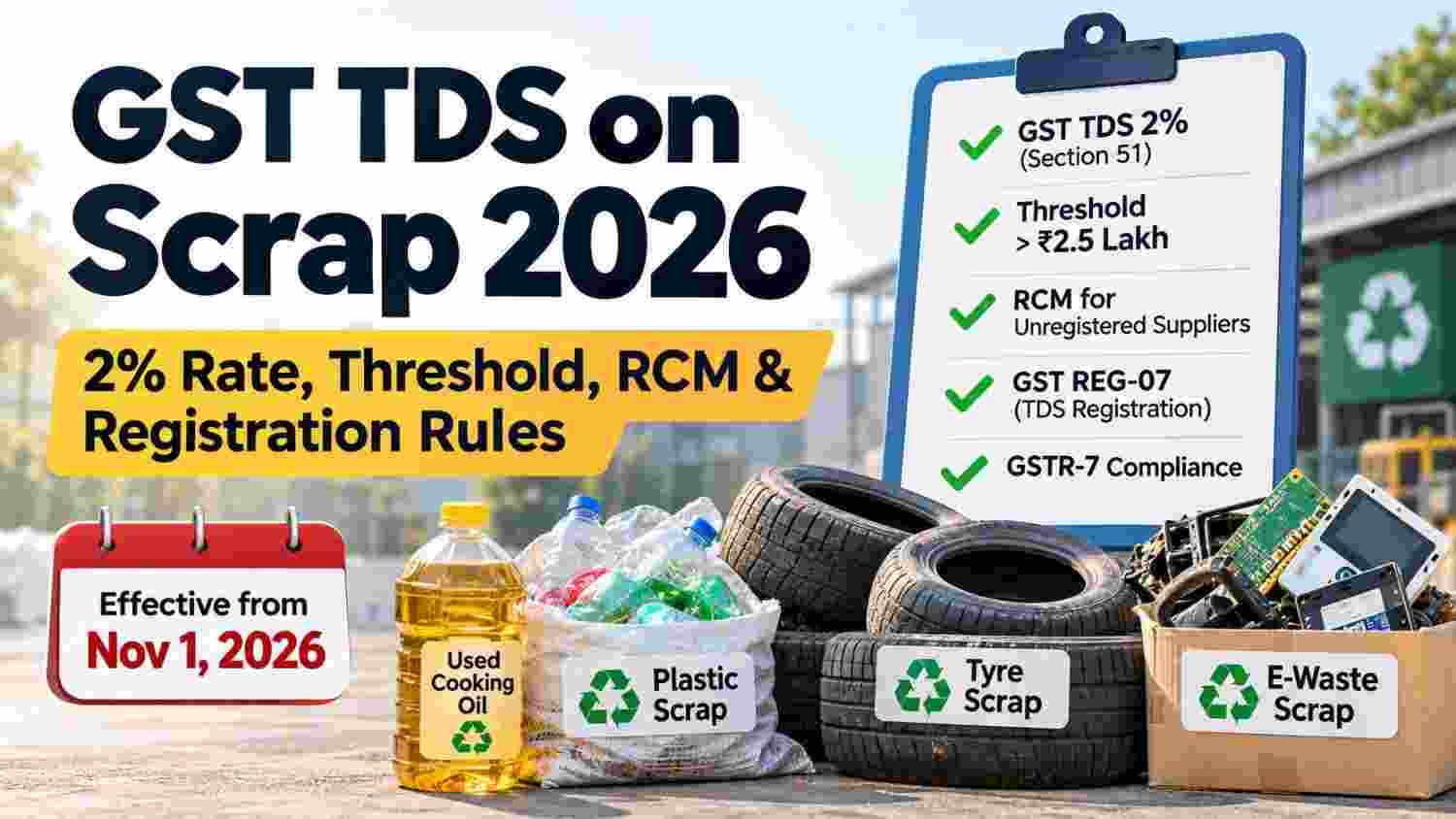
The GST rules for scrap dealers and waste suppliers have changed from November 1, 2026. Additionally, the government has extended the existing GST Tax Deducted at Source (TDS) and Reverse Charge Mechanism (RCM) framework to several new categories. These include used cooking oil, plastic waste, tyre scrap, and electrical and electronic waste.
As a result, scrap dealers, recycling companies, manufacturers, and registered buyers must review their GST compliance requirements. In particular, businesses should understand when they need to deduct 2% GST TDS, when RCM applies, and whether they need GST registration.
This guide explains the new GST TDS on Scrap rules, applicable notifications, registration process, and important compliance requirements for 2026.
Quick Answer: What Are the New GST TDS Rules on Scrap in 2026?
From November 1, 2026, the government has extended GST TDS and RCM provisions to specified supplies of used cooking oil, plastic waste and scrap, tyre waste and scrap, and electrical and electronic waste and scrap.
When a registered supplier sells these specified goods to a registered buyer, the buyer must deduct GST TDS at 2%, subject to Section 51 conditions. These conditions include the applicable contract-value threshold of more than ₹2.5 lakh.
However, when an unregistered supplier sells the specified goods to a registered buyer, the buyer must pay GST under the Reverse Charge Mechanism (RCM).
Additionally, GSTN has issued instructions for the relevant TDS registration process through Form GST REG-07. Therefore, businesses should check their registration and tax responsibilities before making these transactions.
Key Takeaways
The expanded GST provisions apply from November 1, 2026.
Four additional categories have joined the specified metal scrap framework.
GST TDS at 2% applies to specified purchases from registered suppliers, subject to Section 51 conditions.
The general TDS threshold is a taxable contract value exceeding ₹2.5 lakh.
RCM applies when an unregistered person supplies specified goods to a registered buyer.
Registered buyers must manage applicable TDS, GSTR-7, and RCM compliance.
GSTN has explained the TDS registration process through Form GST REG-07.
Suppliers should also review their GST registration requirements under the amended provisions.
1. What Has Changed in GST TDS on Scrap from November 2026?
Earlier, the GST framework covered specified metal scrap transactions under the TDS and RCM provisions. However, the government has now expanded the notified categories through amendments dated October 27, 2026.
The additional categories include:
Furthermore, specified metal scrap under Chapters 72 to 81 was already covered by the earlier framework.
Effective date: November 1, 2026.
Businesses should check the correct tariff classification before applying these rules. For example, not every used product or discarded item automatically qualifies as notified scrap. Therefore, businesses should verify the actual nature and classification of their goods.
Which GST Notifications Introduced These Changes?
Three notifications are particularly important for businesses dealing in the specified goods.
All three changes take effect from November 1, 2026. However, each notification addresses a different compliance requirement. Therefore, businesses should not treat these amendments as a single rule.
2. When Does GST TDS Apply to Scrap Transactions?
GST TDS applies when a registered person receives specified notified goods from another registered person, subject to Section 51 of the CGST Act, 2017.
In this situation, the registered buyer acts as the TDS deductor. The buyer deducts the applicable amount from the payment made or credited to the supplier. After that, the buyer must deposit the deduction with the government.
What Is the GST TDS Rate on Scrap?
The applicable GST TDS rate is 2%.
For an applicable intra-State transaction, the rate generally consists of:
1% CGST
1% SGST or UTGST
For an applicable inter-State transaction, the corresponding IGST TDS treatment applies.
However, businesses should remember that TDS is separate from the GST charged on the goods. Therefore, they must not confuse the 2% TDS deduction with the GST rate applicable to plastic scrap, tyre scrap, used cooking oil or e-waste.
Example of GST TDS on Scrap
Suppose a registered plastic scrap dealer sells specified plastic waste to a registered manufacturing company.
In this case, the buyer should first check the contract value, place of supply, and other statutory conditions. If the transaction satisfies the requirements, the buyer must deduct TDS at the applicable rate.
3. GST TDS Threshold: When Is 2% Deduction Required?
GST TDS does not apply automatically to every scrap purchase. Under Section 51 of the CGST Act, the general threshold applies when the total value of taxable supplies under a contract exceeds ₹2.5 lakh.
For this calculation, businesses should consider the taxable supply value without CGST, SGST, UTGST, IGST, and cess shown in the invoice.
GST TDS Threshold Examples
Therefore, a contract worth exactly ₹2.5 lakh does not cross the threshold. However, a taxable contract value of ₹3 lakh exceeds it.
Important points to remember:
The threshold applies to the total taxable supply value under a contract.
A value of exactly ₹2.5 lakh does not exceed the threshold.
GST and cess shown in the invoice are excluded from the threshold calculation.
The buyer must also check the place-of-supply condition under Section 51.
In particular, Section 51 provides a place-of-supply restriction for specified transactions where the supplier's location and place of supply fall in a State or Union Territory different from the State or Union Territory of the recipient's registration.
Therefore, businesses should review the complete Section 51 conditions before deducting TDS.
4. When Does Reverse Charge Mechanism Apply to Scrap?
The Reverse Charge Mechanism (RCM) applies when an unregistered person supplies specified notified goods to a registered person.
In this arrangement, the registered buyer becomes responsible for paying the applicable GST instead of the supplier. Consequently, the buyer must identify the correct tax rate and report the liability under RCM.
The government introduced the relevant amendment through Notification No. 04/2026-Central Tax (Rate), which amends the existing RCM notification framework.
Example of RCM on Scrap Purchases
Suppose a registered recycling company purchases specified tyre scrap from an unregistered individual.
In this situation, the registered buyer must pay the applicable GST under RCM. Additionally, the buyer should maintain supporting purchase records and report the transaction in the relevant returns.
Does RCM Apply if the Supplier Is Below the GST Registration Threshold?
Yes. The government's GST clarification explains that a registered buyer must pay GST under RCM on specified supplies received from an unregistered supplier, even if that supplier falls below the applicable GST registration threshold.
However, the supplier's registration obligation and the buyer's RCM liability are separate matters. Therefore, businesses should assess both requirements independently.
5. GST TDS vs RCM: What Is the Difference?
Both mechanisms create compliance responsibilities for registered buyers. However, they apply to different supplier situations.
For this reason, buyers should first verify the supplier's GST registration status. After that, they can identify the correct mechanism and complete the required compliance.
6. GST Registration Rules for Scrap Dealers in 2026
The government has also amended the registration exemption framework through Notification No. 06/2026-Central Tax. This notification amends Notification No. 5/2017-Central Tax and removes the specified exemption from registration for persons engaged in supplying the listed goods.
The affected categories include:
Used cooking oil under heading 1518
Plastic waste and scrap under heading 3915
Tyre waste and scrap under heading 4004
Metal scrap under Chapters 72 to 81
Electrical and electronic waste and scrap under heading 8549
However, businesses should not misunderstand this amendment as creating a separate GST registration threshold for every scrap dealer.
The government has clarified that suppliers must obtain GST registration when their aggregate turnover crosses the applicable threshold under Section 22 of the CGST Act.
At the same time, the registered buyer's RCM liability can apply even when the unregistered supplier falls below the registration threshold.
Therefore, businesses should review their turnover, goods classification, existing registration status, and applicable exemptions before deciding their registration requirements.
7. How to Apply for GST TDS Registration Through Form GST REG-07
GSTN issued Advisory No. 684 on November 1, 2026. This advisory explains the TDS registration process for dealers in scrap and other notified goods.
Businesses covered by the TDS registration requirement should follow the instructions in the advisory.
Step-by-Step GST REG-07 Process
First, visit the official GST Portal.
Next, open the registration section and access the applicable TDS registration application, Form GST REG-07.
Then, open Part B of Table 2.
Under Constitution of Business, select Others.
A text box will appear. Enter the relevant business category.
After that, complete the remaining information requested in the form.
Finally, review the details and submit the application.
Examples of Business Categories
Used Cooking Oil Dealers
Waste and Scrap of Plastics Dealers
Waste and Scrap of Tyres Dealers
Electrical and Electronics Waste and Scrap Dealers
Applicants should enter a category that accurately describes their business activity. In addition, they should follow the latest instructions available through the GST portal and GSTN advisory.
Who Should Apply for REG-07?
Form GST REG-07 is relevant to persons who must obtain registration as GST TDS deductors under the applicable provisions.
In these notified scrap transactions, registered buyers responsible for deducting TDS should review this requirement. However, an ordinary scrap supplier should not assume that REG-07 registration is necessary simply because they sell one of the notified goods.
Normal GST registration and TDS deductor registration are separate requirements. Therefore, businesses should assess their specific obligations before applying.
8. Compliance Responsibilities of Registered Buyers
Registered buyers dealing in notified scrap categories should update their accounting and GST compliance processes. In particular, they should maintain separate records for TDS and RCM transactions.
When Buying from a Registered Supplier
Where GST TDS applies, the buyer should:
First, verify the supplier's GST registration status.
Check the contract value and Section 51 conditions.
Deduct TDS at the applicable rate of 2%.
Deposit the deducted amount within the prescribed time.
File the applicable GSTR-7 return.
Issue the prescribed TDS certificate to the supplier.
Maintain purchase records and supporting documents.
When Buying from an Unregistered Supplier
Where RCM applies, the buyer should:
Verify the supplier's registration status.
Confirm that the goods fall under the notified tariff headings.
Determine the applicable GST rate.
Pay GST under RCM.
Report the transaction in the applicable GST returns.
Maintain invoices, purchase records, and payment details.
TDS Deposit and GSTR-7 Filing
A buyer responsible for GST TDS must deposit the deducted amount within the prescribed timeline. Under the general Section 51 framework, the buyer must pay the deducted amount to the government within ten days after the end of the month in which the deduction takes place.
Additionally, the buyer must file Form GSTR-7 for the relevant tax period. The buyer must also issue the prescribed TDS certificate to the supplier within the applicable timeline.
After the buyer completes the required reporting, the supplier can claim eligible TDS credit under the GST provisions.
Therefore, businesses should regularly reconcile the amount deducted, deposited, and reported in GSTR-7. This process can help them identify mismatches before they create compliance issues.
9. Common GST Mistakes Scrap Dealers Should Avoid
The expanded GST framework may create confusion if businesses do not distinguish between TDS, RCM, and registration requirements.
Here are some common mistakes to avoid:
1. Treating TDS as the GST rate: The 2% TDS deduction is separate from the GST rate applicable to the goods. Therefore, businesses should calculate both amounts correctly.
2. Ignoring the ₹2.5 lakh threshold: TDS applicability depends on the taxable contract value and Section 51 conditions. Consequently, buyers should check the threshold before deducting tax.
3. Applying TDS to every scrap purchase: The supplier and buyer must meet the registration requirements. Additionally, the transaction must satisfy the other statutory conditions.
4. Ignoring RCM purchases: A registered buyer may have to pay GST under RCM when purchasing specified goods from an unregistered supplier. Therefore, buyers should review their unregistered purchases carefully.
5. Confusing supplier registration with TDS registration: Normal GST registration and TDS deductor registration are different requirements. For this reason, businesses should not treat them as interchangeable.
6. Selecting the wrong category in REG-07: Applicants should follow the GSTN instructions and enter the correct business category.
7. Missing GSTR-7 compliance: Buyers responsible for TDS should track deposit deadlines, return filing, and TDS certificates.
8. Using incorrect goods classification: Businesses should verify the applicable Customs Tariff heading before deciding whether the notified provisions apply.
10. What Should Scrap Businesses Do Now?
Since the expanded provisions became effective on November 1, 2026, businesses should review their transactions and update their GST compliance processes.
Use the following checklist:
Identify whether the business deals in any notified goods.
Verify the applicable Customs Tariff headings.
Review the GST registration status of suppliers.
Check whether the supplier or buyer must obtain registration.
Separate registered-supplier purchases from unregistered-supplier purchases.
Check the ₹2.5 lakh contract-value threshold for TDS.
Apply TDS or RCM as applicable.
Review whether TDS registration through REG-07 is required.
Update accounting and GST return procedures.
Maintain invoices and supporting transaction records.
Furthermore, businesses dealing in plastic scrap, tyre scrap, used cooking oil, metal scrap or e-waste should review their existing purchase and sales processes. By doing so, they can reduce incorrect deductions and return-reporting errors.
Conclusion
The expansion of GST TDS on Scrap from November 1, 2026, brings important compliance changes for businesses dealing in used cooking oil, plastic waste, tyre scrap, metal scrap and electrical and electronic waste.
Most importantly, businesses must understand the difference between TDS on purchases from registered suppliers and RCM on purchases from unregistered suppliers. Furthermore, they should review the ₹2.5 lakh TDS threshold, supplier registration requirements, Form REG-07 instructions, and GSTR-7 filing obligations.
By checking supplier records, verifying goods classification, and updating accounting procedures, businesses can manage the new GST requirements more effectively.
For professional guidance on GST registration, GST returns, and business tax compliance, learn more about TaxAbide or connect with our team through the Contact Us page.
Disclaimer: This article is for general information and educational purposes. GST treatment depends on the exact goods, tariff classification, transaction value, registration status, and applicable law. Therefore, businesses should verify their specific position with a qualified tax professional before making compliance decisions.
Latest Blogs
You may also find these articles helpful:
GSTR-9 2025-26: Eligibility, Due Date, Reconciliation and Filing Process
Revised Form 161 for Income Tax Penalty Waiver: Eligibility, Rules and Application Process (2026)
Form 145 and Form 146 in 2026: Foreign Remittance Rules, Thresholds & Filing Process
Udyam Registration in Dehradun 2026: Eligibility, Documents, Benefits & Online Process
Income Tax Audit in Dehradun 2026: Turnover Limits, Rules & Applicability