

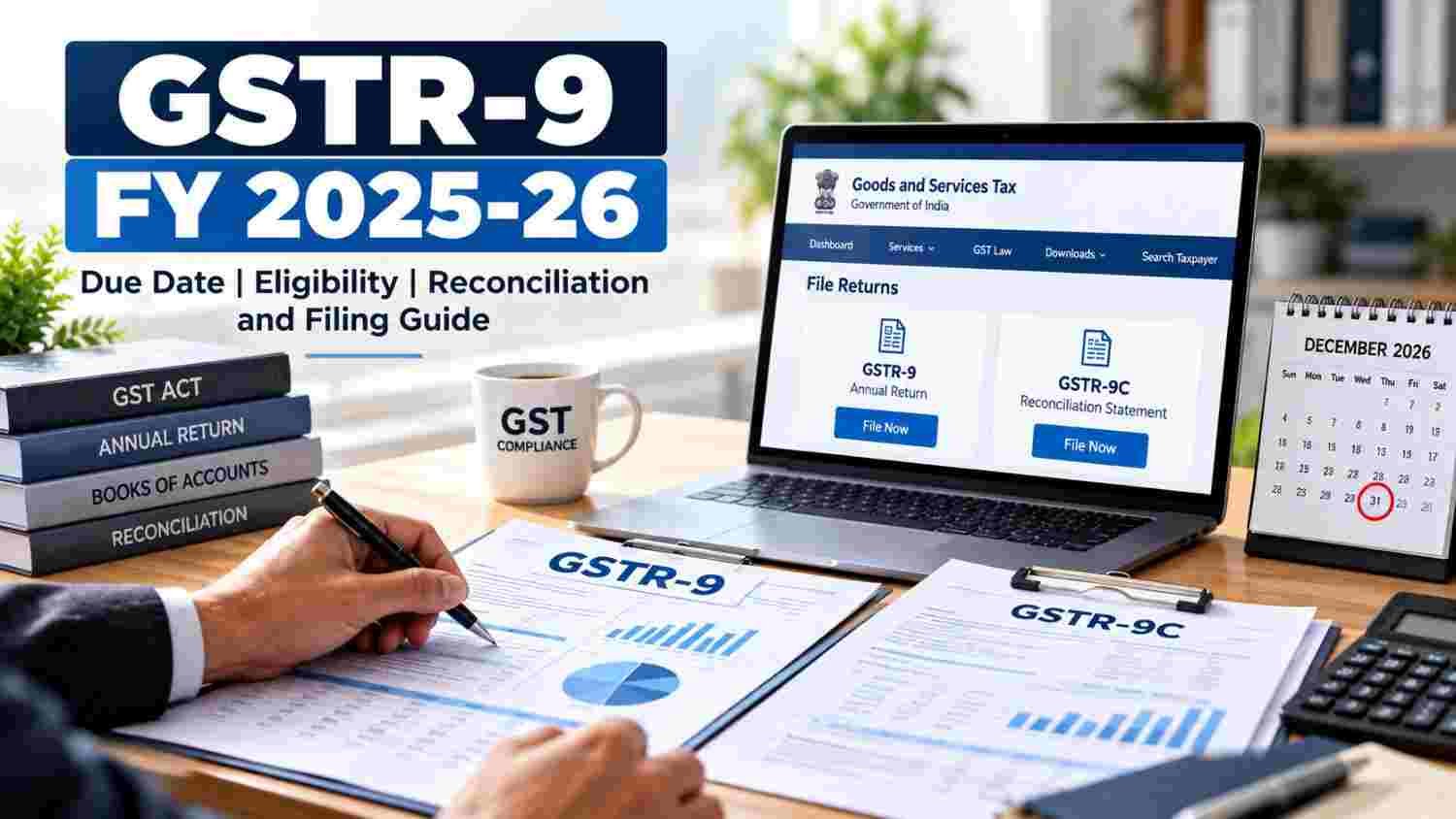
GSTR-9 2025-26: Eligibility, Due Date, Reconciliation and Filing Process
Published: October 30, 2026
Last Updated: October 30, 2026
Quick Answer: What Is GSTR-9 for FY 2025-26?
GSTR-9 for FY 2025-26 is the annual GST return that eligible registered taxpayers must file to report their financial-year GST transactions, outward supplies, input tax credit (ITC), tax paid, and other relevant details. The GST portal enabled filing of GSTR-9 and GSTR-9C for FY 2025-26 from October 8, 2026. The general statutory due date is December 31, 2026, unless the government extends it. Registered persons with aggregate turnover up to ₹2 crore are exempt from filing GSTR-9 under the applicable notification, while GSTR-9C is generally required when aggregate turnover exceeds ₹5 crore, subject to statutory exclusions.
Key Takeaways
GSTR-9 is the annual return under Section 44 of the CGST Act, 2017.
GSTR-9 and GSTR-9C for FY 2025-26 became available on the GST portal on October 8, 2026.
The general due date is December 31, 2026, unless extended.
Eligible registered persons with aggregate turnover up to ₹2 crore are exempt from GSTR-9 filing for FY 2025-26.
GSTR-9C is generally applicable when aggregate turnover exceeds ₹5 crore.
All applicable GSTR-1 and GSTR-3B returns for FY 2025-26 should be filed before accessing the annual return facility.
Reconciliation of GST returns, books of accounts, and ITC records is important before submission.
What Is GSTR-9 for FY 2025-26?
GSTR-9 is an annual GST return that summarises the transactions and tax-related information reported by an eligible registered taxpayer during a financial year.
It consolidates information relating to outward supplies, inward supplies, input tax credit, tax paid, amendments, and other relevant GST details. Businesses use this return to review their periodic GST reporting and provide an annual summary to the tax department.
GSTR-9 is governed by Section 44 of the Central Goods and Services Tax Act, 2017, read with Rule 80 of the CGST Rules, 2017.
For example, a business registered under GST during FY 2025-26 may have filed monthly or quarterly GSTR-1 and GSTR-3B returns throughout the year. GSTR-9 brings the relevant annual information together for reporting and reconciliation.
Important: GSTR-9 is an annual return, not a replacement for monthly or quarterly GST returns.
GSTR-9 FY 2025: Latest GST Updates
The Goods and Services Tax Network (GSTN) enabled the annual return facility for FY 2025-26 on October 8, 2026.
In its advisory dated October 13, 2026, GSTN instructed taxpayers to ensure that all applicable GSTR-1 and GSTR-3B returns for FY 2025-26 had been filed so that the GSTR-9/9C filing tile could become available.
This is important for businesses that are preparing their annual GST compliance. Filing periodic returns is a prerequisite for accessing the annual-return facility.
If the annual-return option is unavailable despite completing the applicable periodic returns, taxpayers can raise a support ticket through the GSTN helpdesk.
GSTR-9 FY 2025: Due Date and Filing Requirements
The general statutory due date for filing GSTR-9 for FY 2025-26 is December 31, 2026.
Under Rule 80 of the CGST Rules, the annual return is generally required to be furnished on or before December 31 following the end of the relevant financial year.
Taxpayers should monitor official GST notifications and advisories for any extension or additional instructions. Do not assume that the due date has been extended unless an official notification confirms it.
GSTR-9 FY 2025: Eligibility Criteria
GSTR-9 applicability depends on the taxpayer's registration category, aggregate turnover, and relevant statutory exemptions.
Generally, eligible regular taxpayers registered under GST must furnish an annual return. However, certain categories are excluded under Section 44 and the applicable rules.
GSTR-9 FY 2025 Turnover Exemption
Under Notification No. 15/2025-Central Tax dated September 17, 2025, registered persons whose aggregate turnover is up to ₹2 crore are exempt from filing GSTR-9 for FY 2024-25 onwards.
Therefore, eligible taxpayers with aggregate turnover up to ₹2 crore for FY 2025-26 are not required to file GSTR-9 under this exemption.
Taxpayers should check the applicable notification and their registration category before deciding not to file.
Who is generally excluded from GSTR-9?
The statutory provisions provide exclusions for specified categories, including:
Input Service Distributors (ISDs).
Persons paying tax under Section 51, relating to tax deduction at source.
Persons paying tax under Section 52, relating to tax collection at source.
Casual taxable persons.
Non-resident taxable persons.
Other categories specifically excluded under the applicable provisions.
Composition taxpayers follow the applicable annual-return requirements, including Form GSTR-4, rather than the regular taxpayer's GSTR-9 process.
Difference Between GSTR-9 and GSTR-9C
GSTR-9 and GSTR-9C serve different but related purposes under GST compliance. While GSTR-9 works as the annual return, GSTR-9C is a self-certified reconciliation statement. It compares relevant figures reported in GST returns with the annual financial statements to identify differences that may require clarification.
GSTR-9 FY 2025: GSTR-9C Turnover Limit
Under Rule 80(3) of the CGST Rules, registered persons whose aggregate turnover exceeds ₹5 crore during a financial year are generally required to furnish GSTR-9C along with GSTR-9.
GSTR-9C is a self-certified reconciliation statement. It should not be confused with the earlier requirement for a compulsory GST audit by a Chartered Accountant or Cost Accountant.
GSTR-9 FY 2025: Documents Required
Before preparing GSTR-9, businesses should collect and organise their GST and accounting records.
The following documents and information can help:
Filed GSTR-1 returns for FY 2025-26.
Filed GSTR-3B returns for FY 2025-26.
Sales register and outward supply details.
Purchase register and expense records.
Input tax credit records and supporting invoices.
Credit notes and debit notes.
Details of amendments made during the financial year.
GST payment and electronic liability ledger details.
Electronic credit ledger and cash ledger information.
Books of accounts and financial statements.
Details of exempt, nil-rated and non-GST supplies, where applicable.
Details of reverse charge transactions, where applicable.
For GSTR-9C, taxpayers should also prepare the relevant annual financial statements and reconciliation workings.
How to Reconcile GSTR-9 FY 2025 With GSTR-1 and GSTR-3B
Reconciliation is one of the most important steps before filing the annual return.
A business may have reported its transactions in periodic GST returns but still have differences between its accounting records, sales register, ITC records, and GST filings.
These differences should be examined before submitting GSTR-9.
Reconcile outward supplies
Compare the sales register and books of accounts with the outward supply details reported in GSTR-1 and the corresponding figures in GSTR-3B.
Review:
Taxable outward supplies.
Exempt and nil-rated supplies.
Export supplies.
Credit notes and debit notes.
Amendments to earlier invoices.
Any differences between GSTR-1 and GSTR-3B.
Reconcile input tax credit.
Compare ITC claimed in GSTR-3B with the relevant purchase records and available GSTR-2B information.
Check:
Eligible ITC.
Ineligible ITC.
Reversed ITC.
Reclaimed ITC, where applicable.
Credit notes affecting ITC.
Differences between books and GST records.
Review tax payments
Check whether the tax liability reported in GSTR-3B matches the relevant accounting and payment records.
Review tax paid through the electronic cash ledger and electronic credit ledger, along with any additional payments or adjustments.
Investigate differences
Do not make adjustments merely to force the figures to match. Identify the reason for each difference and determine whether any correction, additional payment, or disclosure is required under the applicable provisions.
How to File GSTR-9 Online for FY 2025-26
Eligible taxpayers can prepare and submit GSTR-9 through the GST Common Portal.
Follow this general process:
Step 1: Visit the GST portal
Open the official GST website at https://www.gst.gov.in/ and log in using your GST credentials.
Step 2: Open the annual return section
Navigate to Services, then Returns, then Annual Return.
Select the relevant financial year, FY 2025-26.
Step 3: Check GSTR-9 availability
Select the GSTR-9 annual return option. Ensure that all applicable GSTR-1 and GSTR-3B returns for the financial year have been filed.
If the annual return tile is unavailable, review pending returns and follow the GSTN helpdesk instructions if necessary.
Step 4: Review auto-populated information
The portal may display information based on previously filed GST returns.
Review the available tables carefully and compare the figures with your accounting records.
Step 5: Enter and reconcile the required details
Complete the applicable tables relating to outward supplies, ITC, tax paid, and other relevant information.
Check the figures before proceeding.
Step 6: Review the annual return
Preview the prepared return and examine any differences or errors. Ensure that the information is consistent with the books and supporting records.
Step 7: Pay any additional liability, where applicable
If the reconciliation identifies an additional liability, determine the correct payment and reporting procedure under the applicable GST provisions.
Do not assume that every difference can be adjusted directly in GSTR-9.
Step 8: File the return
Complete the prescribed verification and filing process using the available authorised method, such as DSC or EVC, as applicable.
Save the acknowledgement and filed-return records for future reference.
What Should You Do If the GSTR-9 Filing Option Is Not Available?
GSTN's October 13, 2026 advisory specifically asks taxpayers to file all applicable GSTR-1 and GSTR-3B returns for FY 2025-26 before accessing the GSTR-9/9C facility.
If the filing tile is not visible, take these steps:
Check whether any GSTR-1 return for FY 2025-26 is pending.
Check whether any GSTR-3B return for the same financial year is pending.
Confirm that the relevant returns have been successfully filed, not merely saved or prepared.
Log in again and revisit the Annual Return section.
If the problem continues, raise a ticket through the official GSTN helpdesk at https://selfservice.gstsystem.in/.
Keep screenshots and relevant filing acknowledgements if you need to report a technical issue.
Common Mistakes to Avoid While Filing GSTR-9
Annual GST return preparation requires careful review of the financial year's records. Avoid these common mistakes:
Ignoring GSTR-1 and GSTR-3B differences: Differences between outward supply reporting and tax payment records should be investigated before filing.
Incorrect ITC reporting: Check eligible, ineligible, reversed, and reclaimed ITC against supporting records and applicable rules.
Missing amendments and credit notes: Ensure that relevant amendments, debit notes, and credit notes are considered in the appropriate financial-year reporting.
Ignoring exempt and non-GST supplies: These transactions may affect the annual turnover reconciliation and should be reviewed.
Confusing GSTR-9 and GSTR-9C: GSTR-9 is the annual return, while GSTR-9C is the reconciliation statement applicable to qualifying taxpayers.
Waiting until the last day: Starting reconciliation early gives businesses time to identify missing records and resolve differences.
Assuming exemption without checking eligibility: The ₹2 crore exemption and other statutory exclusions should be reviewed before deciding whether filing is required.
How a Chartered Accountant Can Help With GSTR-9 Filing
Preparing an annual GST return involves more than transferring figures from periodic returns. Businesses may need to reconcile accounting records, examine ITC differences, review tax payments, and understand the applicable reporting requirements.
A Chartered Accountant or qualified GST professional can assist with:
Reviewing GSTR-1 and GSTR-3B filings.
Checking GSTR-9 applicability and exemptions.
Reconciling sales and purchase records.
Reviewing ITC eligibility and reversals.
Preparing GSTR-9C where applicable.
Identifying differences between GST returns and financial statements.
Reviewing additional tax liabilities and relevant disclosures.
Completing the annual return filing process.
TaxAbide provides tax and compliance information for individuals and businesses. If you need professional assistance, visit the TaxAbide website or contact the team through the Contact Us page. You can also learn about the organisation on its About Us page.
Conclusion
GSTR-9 FY 2025-26 is an important annual GST compliance requirement for eligible registered taxpayers. With the GST portal enabling annual return filing from October 8, 2026, businesses can begin preparing their records and reconciling their periodic returns.
The general statutory due date is December 31, 2026, unless extended. Taxpayers should verify the ₹2 crore annual-return exemption, the ₹5 crore GSTR-9C threshold, and the applicable statutory exclusions before filing.
Most importantly, reconcile GSTR-1, GSTR-3B, ITC records, and books of accounts carefully. Preparing the annual return early can help businesses identify differences and complete their GST compliance with greater accuracy.
Latest Blogs
You may also find these articles helpful:
Revised Form 161 for Income Tax Penalty Waiver: Eligibility, Rules and Application Process (2026)
Form 145 and Form 146 in 2026: Foreign Remittance Rules, Thresholds & Filing Process
Udyam Registration in Dehradun 2026: Eligibility, Documents, Benefits & Online Process
Income Tax Audit in Dehradun 2026: Turnover Limits, Rules & Applicability
GSTR-1 Filing in October 2026: Due Date, Rules & How to File