
GST Refund Rules 2026: New RFD-01 Changes, Eligibility & Filing Process
Published: November 14, 2026
Last Updated: November 14, 2026
Quick Answer: What Are the GST Refund Rules 2026?
The Central Government notified the Central Goods and Services Tax (Amendment) Rules, 2026 through Notification No. 05/2026-Central Tax dated October 26, 2026.
Under the GST Refund Rules 2026, applicants should select the correct refund category and provide the information required for their specific claim.
The amendments introduce several changes to GST refund procedures:
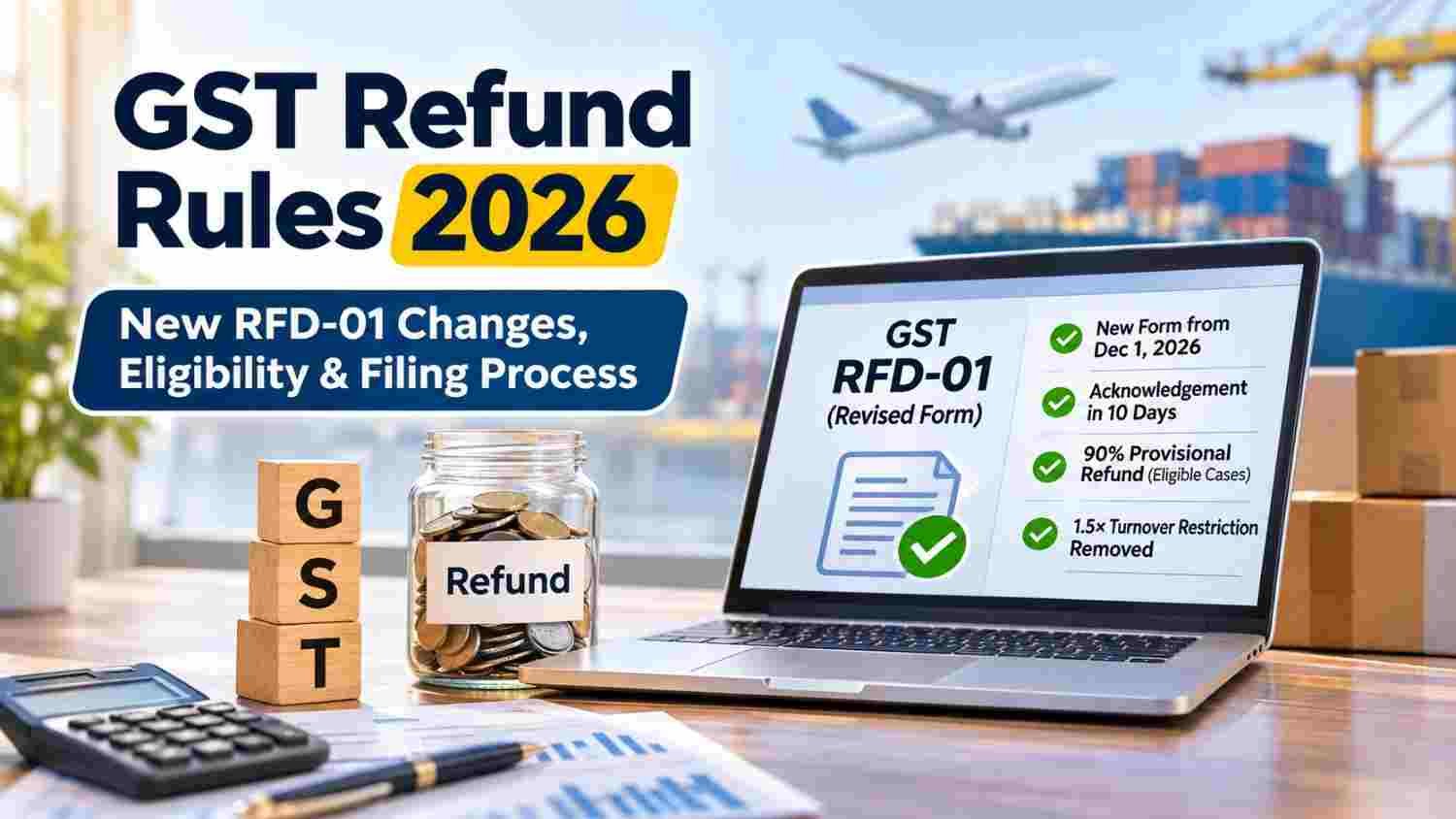
The new FORM GST RFD-01 replaces the existing form from December 1, 2026.
The acknowledgement or deficiency memo timeline under Rule 90 is reduced from 15 days to 10 days.
If the officer does not issue an acknowledgement or deficiency memo within 10 days, the application receives deemed acknowledgement under the amended rule.
Eligible zero-rated and inverted duty structure refund claims can receive risk-based provisional processing.
The 1.5-times domestic value restriction for calculating the turnover of zero-rated goods is removed from November 1, 2026.
The revised RFD-01 form includes additional refund categories, declarations and information fields.
Important: Not every amendment starts on the same date. Therefore, taxpayers should check each provision's effective date before filing a refund application.
Who Should Use This GST Refund Guide?
This GST refund guide is intended for businesses and professionals in India's taxation and financial compliance sector.
Target audience:
Exporters: Businesses claiming refunds on zero-rated exports of goods or services.
Manufacturers: Businesses evaluating GST refunds under the inverted duty structure.
Service providers: GST-registered businesses claiming eligible excess tax or ITC refunds.
SEZ suppliers: Businesses making eligible supplies to Special Economic Zone units or developers.
Tax professionals and consultants: Professionals preparing, reviewing and filing GST refund applications for clients.
When should you use this guide?
Use this guide when checking GST refund eligibility, preparing supporting documents, selecting the correct refund category or filing the revised FORM GST RFD-01.
What decisions does it help you make?
It helps businesses identify the applicable refund category, understand documentation requirements, review relevant filing procedures and decide whether they need assistance from a qualified GST professional.
Key Takeaways
Notification No. 05/2026-Central Tax introduced the CGST Amendment Rules 2026.
The revised RFD-01 form becomes applicable from December 1, 2026.
Rule 90 reduces the acknowledgement or deficiency memo timeline to 10 days.
Eligible zero-rated and inverted duty structure claims can receive provisional refund processing based on system risk evaluation.
The 1.5-times turnover restriction for specified zero-rated goods refunds is removed from November 1, 2026.
The new form includes additional refund grounds and revised declarations.
Applicants should review invoices, GST returns, ITC records and supporting documents before filing.
1. What Are the New GST Refund Rules from December 2026?
The government introduced the new refund-related amendments through Notification No. 05/2026-Central Tax dated October 26, 2026.
These amendments aim to make GST refund applications more structured and improve the processing of eligible claims.
However, businesses should understand that the notification contains changes with different effective dates.
Therefore, taxpayers should not assume that every change in the 2026 amendment applies from December 1.
2. What Is FORM GST RFD-01 Under the GST Refund Rules 2026?
FORM GST RFD-01 is the application used by eligible taxpayers to claim refunds under the GST law.
A taxpayer may use this form to claim eligible refunds relating to:
Excess balance in the Electronic Cash Ledger.
Exports of services with payment of tax.
Exports of goods or services without payment of tax through accumulated ITC.
Refunds arising from inverted duty structure.
Supplies made to SEZ units or developers.
Deemed export supplies.
Excess payment of tax.
Other refund grounds permitted under GST law.
From December 1, 2026, the government will replace the existing RFD-01 form with a revised version under Notification No. 05/2026-Central Tax.
The new form provides a more structured way to report refund information. Additionally, it includes revised fields, refund categories and declarations.
3. What Changes Have Been Introduced in the New RFD-01 Form?
The revised RFD-01 form introduces several changes that applicants should understand before submitting refund claims.
A. Updated Applicant Information
The new form asks for important applicant details, including:
GSTIN or Temporary ID.
Legal name.
Trade name, where applicable.
Current registration status.
Business address.
Applicable tax period.
Refund amount claimed.
Additionally, the applicant must provide the refund amount separately under the relevant tax categories.
B. Revised Refund Categories
The revised form provides a structured list of refund grounds.
Therefore, applicants should select the correct refund category instead of using a general description for every claim.
C. Additional Information and Declarations
The revised form also contains additional information requirements.
For example, applicants may need to provide relevant invoice details, ITC information and supporting statements depending on the refund category.
Furthermore, the form includes declarations relating to the eligibility of the refund claim, non-passing of tax incidence and other applicable statutory conditions.
Applicants should carefully read the declaration applicable to their refund category before submitting the form.
4. GST Refund Rules 2026: New Acknowledgement Timeline
One important amendment relates to the time limit for issuing an acknowledgement or deficiency memo.
Under the amended Rule 90, the relevant period reduces from 15 days to 10 days.
This change applies from November 1, 2026.
What Happens If the Officer Does Not Respond Within 10 Days?
If the proper officer does not issue either an acknowledgement in FORM GST RFD-02 or a deficiency memo in FORM GST RFD-03 within 10 days of filing, the amended Rule 90 provides for deemed acknowledgement.
The GST portal will make the acknowledgement available electronically.
As a result, the date of filing the refund application becomes important for calculating the relevant statutory timeline.
However, a shorter acknowledgement timeline does not mean that every refund will automatically receive final approval within 10 days.
The department or system must still examine the claim according to the applicable refund provisions.
5. GST Refund Rules 2026: Faster Provisional Refund Processing
Yes. The GST Council recommended system-based processing to improve refund timelines and reduce manual intervention.
The reform covers eligible claims relating to:
Excess balance in the Electronic Cash Ledger.
Zero-rated supplies.
Inverted duty structure.
Automatic Refund of Excess Cash Ledger Balance
Under the recommended refund reforms, eligible excess balance refund claims in the Electronic Cash Ledger can receive automatic system-based sanction without officer intervention.
Provisional Refund for Zero-Rated and Inverted Duty Structure Claims
Under Phase I of the refund reforms, the system can automatically sanction 90% of the claimed amount as a provisional refund for eligible, low-risk claims relating to zero-rated supplies and inverted duty structure. The system makes this decision through risk identification and evaluation. However, the proper officer still handles the final scrutiny of the refund claim.
This helps eligible businesses access part of their refund earlier while the remaining claim undergoes the applicable verification.
Risk-Based Processing
Under amended Rule 91, the common portal generates the provisional refund order in FORM GST RFD-04 within three working days after the relevant acknowledgement under Rule 90. The system uses risk identification and evaluation to process eligible claims. Additionally, the amended provision removes the requirement for the proper officer to revalidate this system-generated order.
6. GST Refund Rules 2026: Changes to the Turnover Restriction
Another important refund amendment relates to the calculation of turnover for zero-rated supplies of goods.
Earlier, Rule 89(4)(C) included a restriction that limited the relevant turnover to 1.5 times the value of like goods supplied domestically by the same or a similarly placed supplier, whichever was lower.
The government has removed this restriction through Notification No. 05/2026-Central Tax.
Effective date: November 1, 2026.
This change can affect the calculation of eligible refunds for exporters claiming unutilised ITC on zero-rated supplies.
However, removal of the restriction does not mean that every exporter will automatically receive a higher refund. The applicant must still satisfy the other conditions and refund formula under GST law.
7. Who Can Apply for a GST Refund?
Different taxpayers may claim GST refunds depending on the nature of their transactions and the applicable provisions.
Common categories include:
Exporters
Exporters may claim eligible refunds relating to zero-rated supplies, subject to the applicable conditions.
For example, an exporter supplying goods or services without payment of IGST under a valid Letter of Undertaking may claim eligible accumulated ITC.
Manufacturers
Manufacturers may qualify for refunds under the inverted duty structure provisions when the applicable conditions are satisfied.
SEZ Suppliers
Suppliers making eligible supplies to Special Economic Zone units or developers may claim refunds under the relevant provisions.
Deemed Export Suppliers or Recipients
Eligible suppliers or recipients of deemed export supplies may claim refunds according to the applicable rules and supporting documentation.
Other Eligible Taxpayers
Other registered persons, unregistered persons in eligible situations, tax deductors and tax collectors may also claim refunds under the relevant provisions.
However, refund eligibility depends on the type of claim, statutory conditions, supporting documents and the applicant's circumstances.
8. Documents Required for GST Refund Application
The documents required depend on the refund category. Nevertheless, applicants should prepare the following records before filing.
Additionally, applicants should check the latest RFD-01 instructions for statements, declarations and attachments relevant to their refund category.
9. How to Apply for a GST Refund Online
Eligible taxpayers can submit refund applications through the official GST portal.
Follow these steps:
First, visit the GST Portal.
Log in using your GST credentials.
Navigate to Services → Refunds → Application for Refund.
Select the relevant financial year and tax period, where applicable.
Choose the appropriate refund category.
Enter the required refund amount and transaction details.
Upload or provide the required statements and supporting documents as applicable.
Complete the required declarations and undertakings.
Verify the application carefully.
Submit the application using the applicable electronic verification method.
Save the Application Reference Number (ARN) for future tracking.
From December 1, 2026, applicants should use the revised FORM GST RFD-01 when the new form becomes applicable.
Furthermore, businesses should check the latest portal instructions because the application layout and supporting information requirements may vary by refund category.
10. Common Reasons for GST Refund Delays or Rejection
Even when a business appears eligible for a refund, errors in the application can delay processing.
Here are some common issues to avoid:
Incorrect refund category: Selecting the wrong refund ground can create verification problems.
Invoice mismatches: Differences between invoice details, GST returns and supporting statements can delay processing.
Incorrect ITC calculation: Applicants should verify the eligible credit amount before submitting the claim.
Missing supporting documents: Missing shipping bills, invoices or required declarations can lead to a deficiency memo.
Incorrect bank details: Incorrect account information can create payment-related issues.
Incomplete declarations: Applicants should complete the declarations applicable to their refund category.
Outstanding compliance issues: Businesses should review pending returns and other relevant statutory requirements before applying.
Therefore, a proper reconciliation before filing can help reduce avoidable refund delays.
11. What Should Businesses Do Before December 1, 2026?
Businesses planning to file GST refund applications should prepare for the revised RFD-01 form.
Use this checklist:
Review the refund category applicable to your business.
Reconcile invoices with GSTR-1 and GSTR-3B.
Verify eligible ITC and Electronic Credit Ledger balances.
Check export documents and shipping bill details, where applicable.
Prepare the required statements and declarations.
Verify bank account information.
Review the revised RFD-01 form.
Check the effective date of each amendment.
Keep the ARN and supporting records for future reference.
Additionally, exporters and manufacturers should review the revised refund calculation provisions that apply to their transactions.
Conclusion
The GST Refund Rules 2026 introduce important changes to refund applications and processing. In particular, the revised FORM GST RFD-01 from December 1, 2026, will provide updated refund categories, information fields and declarations.
Additionally, the shorter acknowledgement timeline, system-based provisional refund processing and removal of the 1.5-times turnover restriction can affect eligible businesses and exporters.
Therefore, taxpayers should review the applicable amendments, reconcile their GST records and prepare the required documents before filing refund applications.
For professional guidance on GST refunds, registration and tax compliance, learn more about TaxAbide or connect with our team through the Contact Us page.
Disclaimer: This article is for general information and educational purposes. GST refund eligibility, calculation and processing depend on the applicable provisions, notifications, refund category and supporting documents. Businesses should verify their specific position with a qualified tax professional before filing a claim.
Latest Blogs
You may also find these articles helpful:
GST TDS on Scrap 2026: 2% Rate, Threshold, RCM & Registration Rules
GSTR-9 2025-26: Eligibility, Due Date, Reconciliation and Filing Process
Revised Form 161 for Income Tax Penalty Waiver: Eligibility, Rules and Application Process (2026)
Form 145 and Form 146 in 2026: Foreign Remittance Rules, Thresholds & Filing Process
Udyam Registration in Dehradun 2026: Eligibility, Documents, Benefits & Online Process