
E-Way Bill Number Changes 2027: New 14-Digit Format, GSTN Advisory & Business Impact
Published: November 18, 2026
Last Updated: November 18, 2026
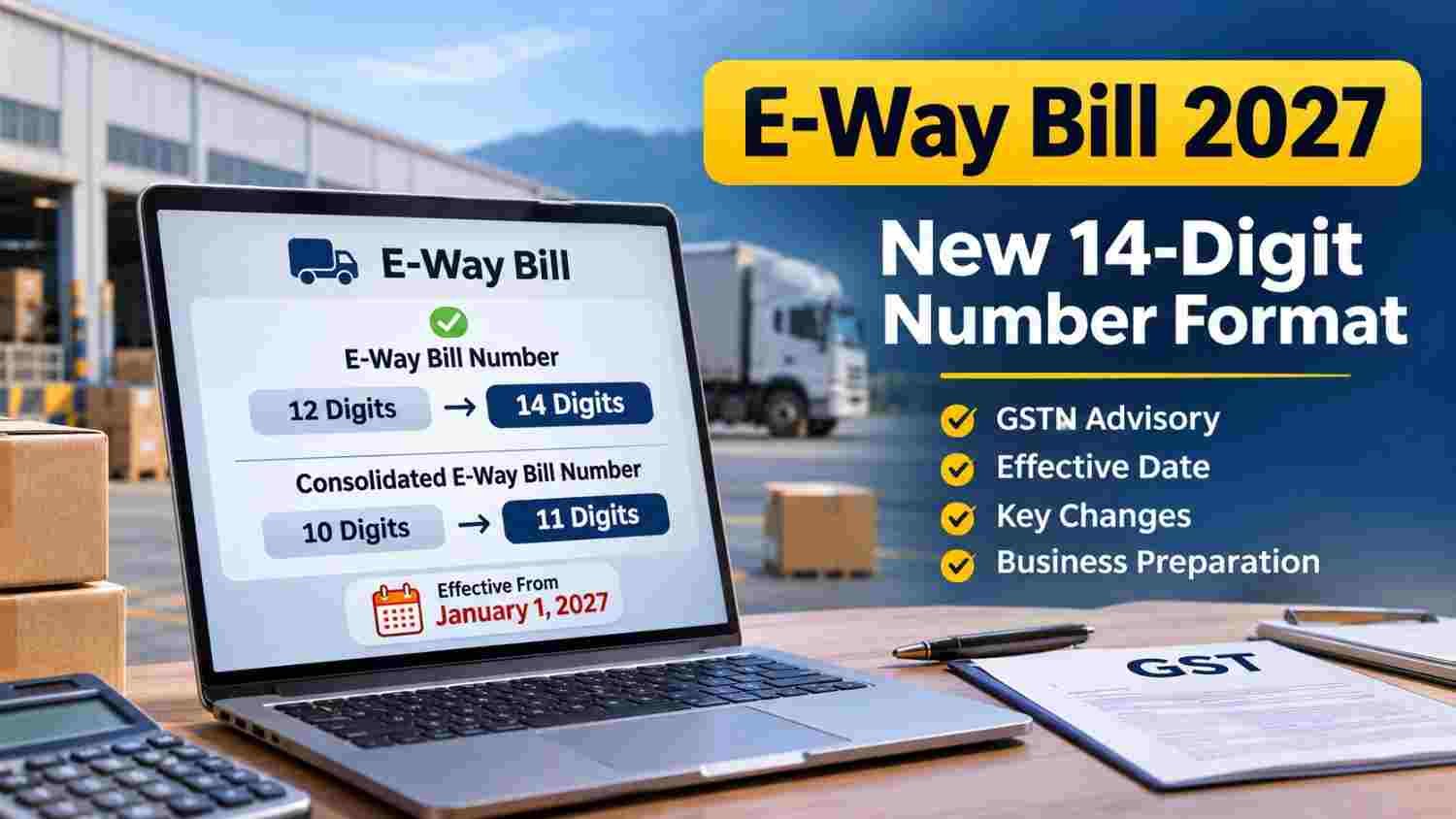
E-Way Bill Number Changes 2027 will introduce a revised numbering format for businesses and transporters using India's GST E-Way Bill system. According to GSTN Advisory No. 687 dated November 4, 2026, the E-Way Bill number is proposed to increase from 12 digits to 14 digits, while the Consolidated E-Way Bill number will change from 10 digits to 11 digits from January 1, 2027.
This update is important for GST-registered businesses, transporters, GST Suvidha Providers (GSPs), ERP software providers and API integrators. Businesses using billing software or automated systems should review their existing number fields and validation settings before the implementation date.
This guide explains the new E-Way Bill number format, the effective date, the reason behind the revision and the practical steps businesses should take to prepare.
Quick Answer: What Are the E-Way Bill Number Changes in 2027?
From January 1, 2027, GSTN proposes to revise the numbering formats of E-Way Bills and Consolidated E-Way Bills.
The revised formats are:
GSTN has advised taxpayers, GSPs, ERP and software providers, and API integrators to update their applications, APIs, database schemas, and validation rules to support the revised formats.
The changes are intended to address the expected exhaustion of the existing numbering capacity due to the substantial volume of E-Way Bills generated.
Effective date: January 1, 2027.
Key Takeaways
GSTN issued Advisory No. 687 on November 4, 2026.
The E-Way Bill number is proposed to increase from 12 digits to 14 digits.
The Consolidated E-Way Bill number is proposed to increase from 10 digits to 11 digits.
The revised formats are proposed to apply from January 1, 2027.
Taxpayers, GSPs, ERP providers and API integrators should prepare their systems.
Database schemas, validation rules, applications and APIs may require updates.
GSTN has stated that Sandbox testing facilities will be released shortly.
Businesses should monitor the official E-Way Bill Portal for further technical instructions.
What Are E-Way Bill Number Changes 2027?
E-Way Bill Number Changes 2027 refer to the revision of the number formats used to identify individual E-Way Bills and Consolidated E-Way Bills under the GST system.
An E-Way Bill is an electronic document generated on the GST E-Way Bill system for the movement of goods, where applicable under GST provisions. It contains a unique identification number that helps identify and track the relevant movement record.
A Consolidated E-Way Bill is generated when multiple E-Way Bills relating to goods being transported in a single vehicle or conveyance are consolidated into one document.
Under GSTN's November 4, 2026 advisory, these identification numbers will have additional digits from January 1, 2027.
Importantly, the advisory concerns the numbering format. It does not announce a new E-Way Bill tax rate, a change in the general registration threshold or a new requirement to generate an E-Way Bill.
1. What Has Changed in the New E-Way Bill Format?
The main change is the length of the identification numbers.
GSTN has proposed the following revisions:
For example, systems currently configured to accept only 12-digit E-Way Bill numbers may need to accommodate 14-digit numbers.
Similarly, software that stores Consolidated E-Way Bill numbers in 10-character fields should be reviewed for the revised 11-digit format.
These are format illustrations, not actual E-Way Bill numbers.
2. Why Is GSTN Changing the E-Way Bill Number Format?
GSTN has explained that the existing numbering capacity is expected to be exhausted because of the substantial volume of E-Way Bills generated.
As businesses across India continue to use the electronic system for goods movement, the number of generated records increases. Therefore, revising the number format is intended to provide additional numbering capacity.
The change is also relevant for businesses that rely on technology to generate, receive, store and share E-Way Bill information.
GSTN has specifically advised stakeholders to make the required technical modifications well before January 1, 2027, to avoid disruption in E-Way Bill-related operations.
3. When Will the New E-Way Bill Number Format Apply?
The revised numbering formats are proposed to take effect from January 1, 2027.
Businesses should note that GSTN has not specified a separate exact date for the Sandbox release in the advisory.
Therefore, software providers and businesses should monitor the official E-Way Bill Portal for further technical instructions.
4. Who Will Be Affected by the New E-Way Bill Number Format?
The change is relevant to stakeholders who generate, receive, process or store E-Way Bill numbers.
The GSTN advisory specifically identifies the following groups:
1. GST-registered taxpayers
Businesses generating E-Way Bills should check whether their billing and accounting systems can accept the revised number length.
2. Transporters
Transporters should review their transport management systems, vehicle records and document-sharing processes to ensure that longer E-Way Bill numbers are stored and displayed correctly.
3. GST Suvidha Providers (GSPs)
GSPs should review their applications and integrations to accommodate the revised number formats.
4. ERP and billing software providers
Software providers should examine database fields, validation rules, reports and other features that process E-Way Bill numbers.
5. API integrators
Businesses and technology providers using APIs should review request and response handling to ensure that the revised numbers are accepted and processed correctly.
5. How Will the New E-Way Bill Format Affect Businesses?
The change may require technical updates even if a business does not generate E-Way Bills directly through an API.
For example, a business may generate an E-Way Bill through an integrated software platform and then transfer the number into its accounting system, dispatch register or transporter's application.
If any connected system is still configured for the old number length, it may reject, truncate or incorrectly display the revised number.
Here are some areas businesses should review:
The actual changes required will depend on the software and integrations used by each business.
6. What Should Businesses Do Before January 1, 2027?
Businesses should start reviewing their systems before the new format becomes applicable.
The following preparation checklist can help:
Step 1: Identify where E-Way Bill numbers are stored
List all software, databases, spreadsheets, invoices and reports that store E-Way Bill numbers.
Step 2: Check existing field lengths
Review whether database fields and software inputs are limited to 12 digits for E-Way Bills or 10 digits for Consolidated E-Way Bills.
Step 3: Update validation rules
Ask the software provider to ensure that the revised 14-digit and 11-digit formats can be accepted.
Step 4: Contact your ERP or software provider
Confirm whether the required updates will be included in the software version used by your business.
Step 5: Review API integrations
Businesses using APIs or GSP services should confirm that their integrations can process the revised number formats.
Step 6: Check printed documents and reports
Review invoices, dispatch documents, transport records, PDF reports and Excel exports to ensure that longer numbers are displayed completely.
Step 7: Test the updated systems
GSTN has stated that the changes will be released in the Sandbox environment shortly for testing. Once available, businesses and software providers should use the relevant testing facilities and follow the published technical instructions.
7. Will Existing 12-Digit E-Way Bill Numbers Become Invalid?
GSTN Advisory No. 687 announces the proposed revised numbering formats from January 1, 2027. However, it does not provide detailed instructions about the treatment of previously generated E-Way Bill numbers.
Therefore, businesses should not assume that existing E-Way Bills will automatically be renumbered or become invalid.
They should continue to maintain their historical E-Way Bill records and wait for GSTN's further technical instructions regarding the transition and system handling of old and new number formats.
Software providers should also consider historical records when updating validation rules and database fields.
8. Does the New E-Way Bill Number Format Change GST Compliance Rules?
The November 4, 2026 advisory is specifically about the numbering formats of E-Way Bills and Consolidated E-Way Bills.
It does not announce changes to GST tax rates, input tax credit eligibility, the general E-Way Bill generation threshold or the applicable movement-of-goods requirements.
Businesses should continue to follow the relevant provisions of the CGST Act, 2017 and the CGST Rules, 2017, along with applicable notifications and instructions.
The revised numbering format should therefore be treated as a technical system-readiness requirement rather than a new tax liability.
9. What Should ERP and Software Providers Check?
ERP and software providers have an important role in ensuring a smooth transition.
A number-format update should not be limited to changing the visible input field. Providers should review all the connected areas where E-Way Bill numbers are processed.
Their review should include:
Database field lengths and data types.
Input validation and number-format checks.
API request and response handling.
Data exchange between ERP and GSP platforms.
Transporter and warehouse integrations.
Invoice, dispatch and transport document layouts.
PDF, Excel and CSV exports.
Historical record retrieval and reconciliation.
Testing of updated software after GSTN releases the Sandbox changes.
A system that accepts a 14-digit number on one screen but stores only 12 digits in its database may still create an operational problem.
Therefore, end-to-end testing is important before the revised format is used in live business operations.
Conclusion
E-Way Bill Number Changes 2027 are an important technical update for businesses using India's GST E-Way Bill system. Under GSTN Advisory No. 687 dated November 4, 2026, the E-Way Bill number is proposed to increase from 12 digits to 14 digits, while the Consolidated E-Way Bill number will increase from 10 digits to 11 digits from January 1, 2027.
Businesses should review their ERP systems, billing software, databases, APIs and document formats before the implementation date. They should also coordinate with their software providers and monitor GSTN's Sandbox testing and technical updates.
Early preparation can help businesses reduce avoidable validation errors and maintain smoother E-Way Bill-related operations.
For assistance with GST compliance and business tax matters, visit TaxAbide or connect with our team through the Contact Us page.
Disclaimer: This article is for general information and educational purposes only. It is based on the GSTN advisory available as of November 18, 2026. Further technical instructions may be issued by GSTN. Businesses should refer to official GST Portal updates and consult a qualified tax professional or software provider for their specific requirements.
Latest Blogs
You may also find these articles helpful:
GST Refund Rules 2026: New RFD-01 Changes, Eligibility & Filing Process
GST TDS on Scrap 2026: 2% Rate, Threshold, RCM & Registration Rules
GSTR-9 2025-26: Eligibility, Due Date, Reconciliation and Filing Process
Revised Form 161 for Income Tax Penalty Waiver: Eligibility, Rules and Application Process (2026)
Form 145 and Form 146 in 2026: Foreign Remittance Rules, Thresholds & Filing Process