
New Income Tax Forms 2026: Old vs New Form Numbers Explained
Published: August 18, 2026
Last Updated: August 18, 2026
The Income Tax system in India has changed significantly with the introduction of the Income Tax Act, 2025. Along with the new Act, several new forms have been introduced for taxpayers, businesses, professionals, and other entities from April 1, 2026.
If you are searching for New Income Tax Forms 2026, one important thing to understand is that the old and new forms are being used during a transition period. Forms relating to periods governed by the Income Tax Act, 1961 continue to apply, while new forms are being introduced for the new Act. The Income Tax Department's e-Filing portal currently supports both systems.
This guide explains the major Income Tax Form Changes 2026, how the new numbering works, and what taxpayers should know before selecting a form.
Quick Answer
New Income Tax Forms 2026 are forms prescribed under the Income Tax Rules, 2026 for transactions and compliances governed by the Income Tax Act, 2025. During the transition, old forms continue to apply to earlier periods, while new forms are available for Tax Year 2026-27 onwards.
The Income Tax Department has also introduced a form-mapping system to help taxpayers understand the relationship between the old and new forms.
Key Takeaways
The Income Tax Act, 2025 brought a new set of statutory forms from April 1, 2026.
Old forms have not simply disappeared; they continue to apply where the Income Tax Act, 1961 governs the relevant period.
The e-Filing portal supports both old and new forms during the transition.
Several new forms use different numbers from their earlier counterparts.
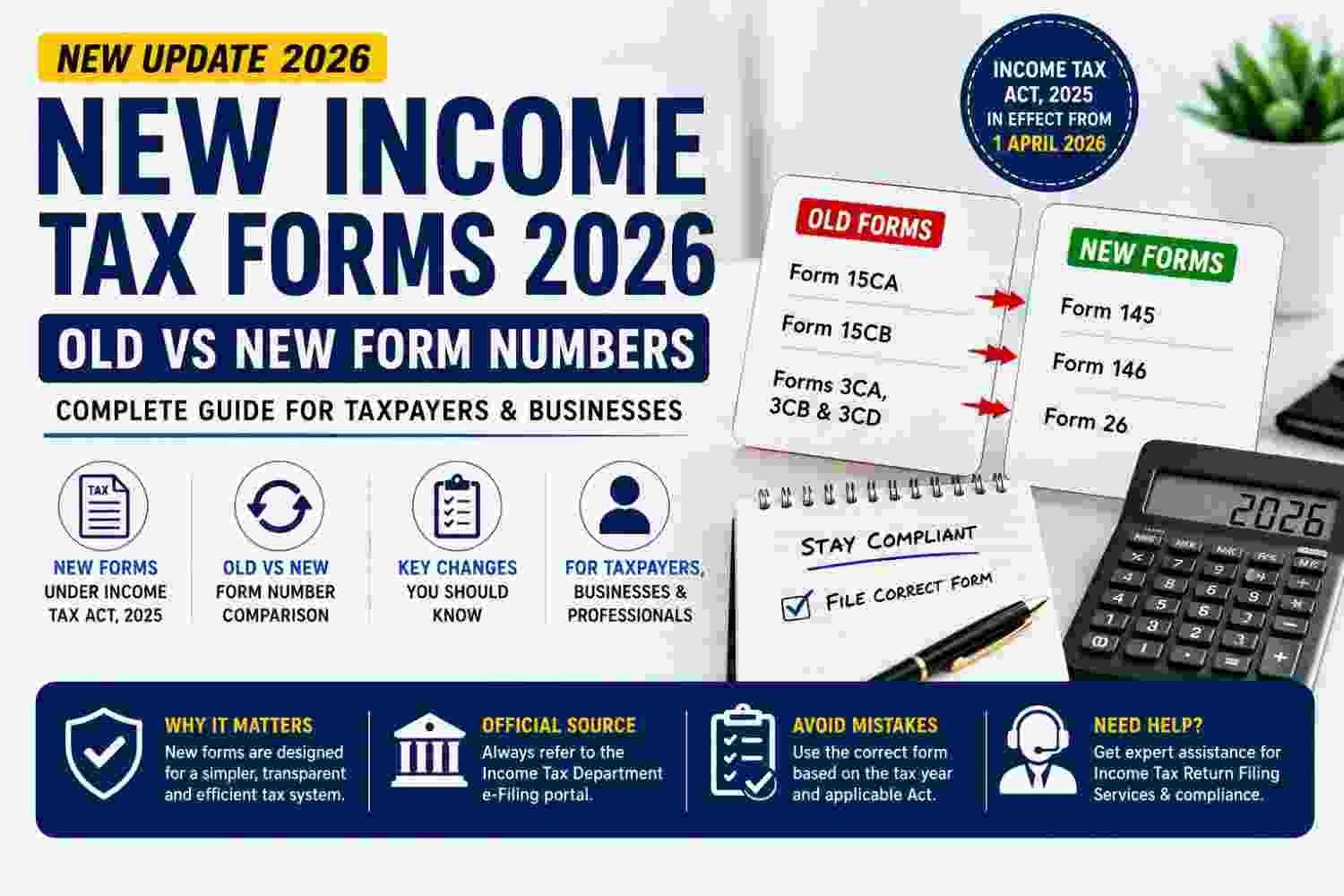
Form 145, for example, replaces the earlier Form 15CA for specified foreign remittances.
Form 146 is the new accountant's certificate corresponding to the earlier Form 15CB.
Taxpayers should select the correct year and applicable Act before filing a form.
What Are the New Income Tax Forms 2026?
The New Income Tax Forms 2026 are statutory forms prescribed under the Income Tax Rules, 2026 for the new income-tax framework.
These forms cover different requirements, including tax registrations, reporting, certificates, remittances, tax audits and other compliance-related activities.
The Income Tax Department is rolling out these forms through its e-Filing portal. It has also made additional quarterly forms available as part of the rollout of the new statutory forms.
Therefore, taxpayers should not assume that every old form has simply received a new number. Some forms have been replaced, some have been merged, and others have been redesigned under the new framework.
Why Were New Income Tax Forms Introduced?
The new forms were introduced as part of the transition to the Income Tax Act, 2025 and the Income Tax Rules, 2026.
The objective is not just to change form numbers. Several forms have been redesigned or consolidated to align with the new law and make reporting more structured.
For example, the new Form 26 combines the earlier Forms 3CA, 3CB and 3CD for tax audit reporting for Tax Year 2026-27. The Income Tax Department describes it as a unified tax audit form with structured reporting and new schedules.
Old vs New Income Tax Forms: How Does the Transition Work?
The transition is important because taxpayers may encounter both old and new forms in 2026.
The Income Tax Department has stated that the e-Filing portal will support both old forms for AY 2026-27 and earlier and new forms for Tax Year 2026-27 onwards during the transition.
So, don't choose a form only by looking at its number. First identify the relevant tax year and the law applicable to your transaction.
What Are the Major Income Tax Form Changes in 2026?
One of the biggest changes is the introduction of new form numbers for several existing compliance requirements.
For example:
Form 15CA → Form 145
Form 15CB → Form 146
Forms 3CA, 3CB and 3CD → Form 26 for tax audit reporting under the new Act.
These are only examples. The Income Tax Department has published a broader set of new statutory forms and corresponding guidance on its e-Filing portal.
What Is New Form 145?
Form 145 is a new form used for furnishing information relating to specified payments to a non-resident or a foreign company.
It replaces the earlier Form 15CA under the new framework.
The Income Tax Department states that Form 145 is filed before making the relevant remittance and contains different parts depending on the taxability of the remittance and the applicable circumstances.
For example, where a taxable remittance exceeds ₹5 lakh in a tax year, different requirements can apply depending on whether an Assessing Officer certificate or an accountant's certificate is involved.
What Is New Form 146?
Form 146 is an accountant's certificate used in specified cases involving taxable payments to a non-resident or foreign company.
Under the earlier Income Tax Act, this requirement was associated with Form 15CB.
The new Form 146 is used in connection with Form 145 Part C where the prescribed conditions are met. The Income Tax Department states that the CA must be registered on the e-Filing portal and have a valid Digital Signature Certificate for electronic submission.
Expert Tip
If your business regularly makes payments to foreign vendors, consultants, or other non-residents, don't rely on an old Form 15CA/15CB checklist without checking the applicable 2026 requirements.
Which Old and New Income Tax Forms Changed in 2026?
The Income Tax Form Changes 2026 are not limited to one or two forms. The Income Tax Department has published a mapping guide to help taxpayers identify the corresponding forms under the Income Tax Act, 2025. The e-Filing portal separates forms into those under the 1961 Act, the 2025 Act, and other applicable laws.
Some important changes include:
These are examples from the official form mapping. The complete list is broader, so taxpayers should refer to the latest Income Tax Department mapping before filing.
What Is the New Form 26?
Form 26 is the new tax audit report under the Income Tax Rules, 2026 for Tax Year 2026-27.
It consolidates the earlier Forms 3CA, 3CB and 3CD into a single form under the new framework. The new form also uses structured schedules and includes disclosures such as the auditor's membership number, firm registration number and UDIN.
However, this change applies to the new framework.
For FY 2025-26 (AY 2026-27), the existing Forms 3CA, 3CB and 3CD continue to apply under the Income Tax Act, 1961. For Tax Year 2026-27, Form 26 applies under the new Act.
Simple Example
A business completing its tax audit for FY 2025-26 should not automatically switch to Form 26.
Instead:
FY 2025-26 → AY 2026-27 → Forms 3CA/3CB/3CD
Tax Year 2026-27 → Form 26
This distinction is important during the transition.
Are PAN and TAN Forms Also Changing?
Yes. New PAN and TAN application forms have been introduced under the Income Tax Rules, 2026.
However, existing PAN and TAN numbers remain valid. The new forms apply to fresh applications made on or after April 1, 2026. The Income Tax Department specifically states that existing PAN/TAN numbers are not affected by the new form numbering.
Therefore, if you already have a PAN or TAN, you do not need to obtain a new number simply because the forms have changed.
What Happens to Old Income Tax Forms?
Old forms have not become invalid in every situation.
The applicable form depends on the tax period, transaction date and Act governing the compliance.
For example, forms relating to income or transactions governed by the Income Tax Act, 1961 may continue to be used for the relevant period. Meanwhile, forms under the Income Tax Act, 2025 apply to the new framework.
The Income Tax Department's e-Filing portal currently provides separate options for forms under both Acts.
Are Form 15CA and Form 15CB Replaced?
Yes, for remittances governed by the new framework.
Form 145 replaces Form 15CA, while Form 146 replaces Form 15CB under the Income Tax Act, 2025.
However, Form 15CA and Form 15CB already submitted for qualifying remittances made before April 1, 2026, can continue to remain valid subject to the applicable conditions. For remittances made on or after April 1, 2026, the new Forms 145 and 146 apply.
Who Needs to Use the New Income Tax Forms?
There is no single taxpayer category that uses every new form.
The applicable form depends on what you are doing.
For example:
A business undergoing a tax audit may need Form 26 under the new Act.
A person making a specified payment to a non-resident may need Form 145.
A Chartered Accountant may need Form 146 in the prescribed circumstances.
A person making a fresh PAN application from April 1, 2026 uses the applicable new PAN form.
Therefore, New Income Tax Forms 2026 should be understood as a complete group of forms rather than one particular document.
Where Can You Find the New Income Tax Forms?
The Income Tax Department has made the new forms available through its e-Filing portal.
The current portal provides a dedicated section for forms under the Income Tax Act, 2025. It has also rolled out additional statutory and quarterly forms during 2026.
Before filing, check the latest form available on the official portal instead of downloading an old copy from an unrelated website.
What Should Businesses Check Before Filing?
Businesses should pay particular attention to the applicable Act and Tax Year before submitting a form.
A simple checklist is:
Identify the transaction or compliance requirement.
Determine the relevant tax year or period.
Check whether the Income Tax Act, 1961 or 2025 applies.
Find the corresponding form on the official e-Filing portal.
Check the latest instructions and prerequisites.
Complete the form and submit it using the prescribed method.
This approach can help prevent the common mistake of selecting a form based only on its old number.
Why Is the Old vs New Form Comparison Important?
The biggest challenge during the transition is not necessarily the form itself. It is knowing which form applies to which situation.
For instance, someone familiar with Form 15CA may search for the same form in 2026 and assume that it is still the correct option. Under the new Act, however, the corresponding form is Form 145 for applicable remittances.
Similarly, a taxpayer familiar with Forms 3CA, 3CB and 3CD needs to understand that Form 26 is the corresponding tax audit form for Tax Year 2026-27.
Expert Tip
Don't rely on an old form checklist simply because the transaction looks familiar. Check the applicable Act and the latest form mapping first.
What Should Taxpayers Do Before Using a New Income Tax Form?
The introduction of New Income Tax Forms 2026 means taxpayers need to be more careful about the form they select. The same type of compliance may now have a different form number under the Income Tax Act, 2025.
Before submitting any form, check:
The relevant Tax Year or earlier assessment period.
Whether the Income Tax Act, 1961 or 2025 applies.
The latest form number on the Income Tax Department portal.
The eligibility and filing requirements.
Whether a CA, employer, Assessing Officer or another authorised person is involved.
Whether digital signatures or other authentication are required.
The Income Tax Department recommends using the latest forms and instructions available on its e-Filing portal. (incometax.gov.in)
Can Businesses Still Use Old Income Tax Forms?
Yes, where the old Income Tax Act and its applicable compliance requirements continue to govern the relevant period.
For example, FY 2025-26 relating to AY 2026-27 continues under the earlier framework. Therefore, businesses should not replace every old form with a new form simply because the new forms have been introduced.
On the other hand, compliance relating to Tax Year 2026-27 onwards may require the corresponding forms under the Income Tax Act, 2025.
This transition is why checking the applicable tax period before filing is important.
What Are the Common Mistakes to Avoid?
Businesses and taxpayers should avoid these mistakes when dealing with the new forms:
Using an old form without checking the applicable tax period.
Assuming every old form has the same purpose under the new Act.
Choosing a form only because its number looks familiar.
Ignoring the latest Income Tax Department instructions.
Using outdated information from older tax articles.
Confusing AY 2026-27 requirements with Tax Year 2026-27 requirements.
A quick check of the official form mapping can prevent many of these errors.
How Can Professional Tax Support Help?
The transition can be confusing for businesses that handle multiple tax compliances. A professional can help identify the applicable form, review supporting information, and guide you through the filing process.
If you need help with Income Tax Return Filing Services, tax professionals can also assist with return preparation, documentation, and other income-tax compliances.
For businesses that regularly deal with tax filings, professional guidance can be useful when the applicable rules or form numbers have changed.
Why Should You Check the Official Income Tax Portal?
Tax forms and filing procedures can change. Therefore, information published several years ago may not always reflect the current requirements.
The official Income Tax Department portal should be your first source for:
New form numbers
Form instructions
Filing procedures
Applicable tax periods
New Act requirements
PAN and TAN forms
Tax audit forms
The department's forms section provides access to forms under the applicable income-tax framework. (incometax.gov.in)
Final Takeaway
The New Income Tax Forms 2026 are part of the transition to the Income Tax Act, 2025. The biggest change for taxpayers is that several familiar forms now have new numbers or have been consolidated.
The easiest examples to remember are:
Form 15CA → Form 145
Form 15CB → Form 146
Forms 3CA, 3CB & 3CD → Form 26 for the new tax audit framework.
However, don't assume that every old form has become invalid. The applicable form depends on the tax period and the law governing the particular compliance.
Before filing, always check the latest official Income Tax Department guidance. If you need professional assistance with Income Tax Return Filing Services or other tax compliances, getting expert guidance can help you avoid using the wrong form.
For TaxAbide's professional tax support, you can explore our About Us page or Contact Us for assistance.
Related Blogs