
Tax Year vs Assessment Year: What Changes From 2026?
Published: August 14, 2026
Last Updated: August 14, 2026
If you file income tax in India, you may already know terms such as Financial Year, Previous Year, and Assessment Year. However, from April 1, 2026, the Income Tax Act, 2025 introduces an important terminology change. The term Tax Year replaces the earlier Previous Year concept, while the Assessment Year concept is discontinued under the new Act.
So, what is the difference between Tax Year vs Assessment Year? In simple terms, Tax Year refers to the period in which income is earned. For most taxpayers, it follows the same April to March period as the Financial Year. The old Assessment Year continues to matter for earlier periods governed by the Income Tax Act, 1961.
This guide explains the change with simple examples, so you can understand what happens to FY 2025 26, AY 2026 27, and Tax Year 2026 27.
Quick Answer
Tax Year is the new term introduced under the Income Tax Act, 2025, from April 1, 2026. It replaces the Previous Year concept and generally corresponds to the Financial Year in which income is earned. The Assessment Year continues for periods governed by the Income Tax Act, 1961, but there is no Assessment Year concept under the new Act.
Key Takeaways
Tax Year applies from April 1, 2026, for income earned from FY 2026 27 onwards.
Tax Year generally follows the April to March Financial Year.
Previous Year is replaced by Tax Year under the new Act.
Assessment Year remains relevant for earlier periods covered by the Income Tax Act, 1961.
Tax Year 2026 27 relates to income earned during FY 2026 27.
Businesses do not need to change their accounting period because of this terminology change.
What Is a Tax Year?
A Tax Year is a period of twelve months contained within a Financial Year. Under the Income Tax Act, 2025, it replaces the Previous Year terminology used under the Income Tax Act, 1961.
For most taxpayers, the Tax Year starts on April 1 and ends on March 31 of the following year.
For example:
April 1, 2026 to March 31, 2027 = Tax Year 2026 27
This makes the terminology easier because the year in which you earn income is also the year used to identify the Tax Year.
What Is an Assessment Year?
Under the earlier Income Tax Act, 1961, the Assessment Year was the year immediately following the Previous Year.
For example, income earned during FY 2025 26 was considered income ofthe Previous Year 2025 26 and was assessed under Assessment Year 2026 27.
Under the Income Tax Act, 2025, the Assessment Year concept has been discontinued for the new framework.
Therefore, you should not assume that Assessment Year 2026 27 and Tax Year 2026 27 refer to the same income period.
They do not.
Tax Year vs Assessment Year: What Is the Difference?
The easiest way to understand the change is through a comparison.
The Income Tax Department explains that Tax Year corresponds to the Previous Year concept under the old Act and aligns with the Financial Year.
Is Tax Year the Same as Financial Year?
For most taxpayers, Tax Year and Financial Year cover the same April to March period.
For example:
Financial Year 2026 27 = Tax Year 2026 27
However, the two terms are not identical in every legal or accounting context. Financial Year is a broader financial concept, while Tax Year is the terminology used under the Income Tax Act, 2025.
There is also an exception for a newly started business or a new source of income. In such cases, the Tax Year can be shorter than a complete Financial Year. For example, a business started on December 1, 2026 can have a Tax Year from December 1, 2026 to March 31, 2027.
Expert Tip
When you see Tax Year 2026 27, simply remember the period from April 1, 2026 to March 31, 2027.
Tax Year 2026 27 vs Assessment Year 2026 27
This is where many taxpayers can get confused.
Although the year numbers look similar, they refer to different income periods.
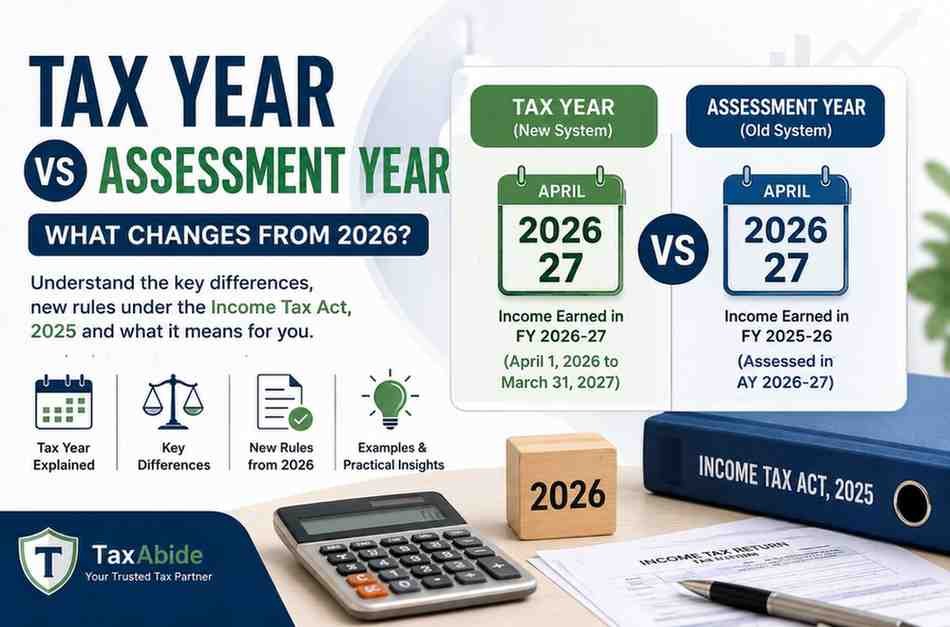
For income earned from April 1, 2025 to March 31, 2026:
FY 2025 26 → Previous Year 2025 26 → AY 2026 27
For income earned from April 1, 2026 to March 31, 2027:
FY 2026 27 → Tax Year 2026 27
So, AY 2026 27 is not the same as Tax Year 2026 27.
The Income Tax Department has specifically clarified this transition.
What Happens to Assessment Year After 2026?
The Assessment Year concept has been discontinued under the Income Tax Act, 2025, for the new framework.
However, this does not mean that every reference to Assessment Year disappears immediately.
Earlier tax periods continue to be handled under the applicable provisions of the Income Tax Act, 1961. Therefore, AY 2026 27 remains relevant for income earned during FY 2025 26.
During the transition, you may therefore see both Assessment Year and Tax Year references.
What Is the Difference Between Previous Year and Tax Year?
Under the old system:
Previous Year = year in which income is earned
Under the new system:
Tax Year = year in which income is earned
The new terminology is intended to remove the confusion created by using two different year references for earning and assessment.
Which Act Applies to Tax Payments in 2026?
This is an important practical question.
For payments relating to Tax Year 2026 27 onwards, the Income Tax Act, 2025 applies.
For payments relating to periods before Tax Year 2026 27, including AY 2026 27 or earlier, the Income Tax Act, 1961 applies. The Income Tax Department has provided specific guidance for this transition.
So, do not select a tax year only because the year number looks familiar. First identify the period to which your income or tax liability relates.
What Does This Change Mean for ITR Filing?
The terminology change does not mean that every existing return suddenly changes to Tax Year.
For income relating to FY 2025 26, the old framework and AY 2026 27 remain applicable.
For income relating to FY 2026 27 onwards, the new Tax Year framework applies. The Income Tax Department's current systems also distinguish between the applicable Act and the corresponding AY or TY.
Therefore, always check the applicable Act before filing a return or making a tax payment.
What Should Salaried Employees Know?
Salaried employees may see the new terminology in tax-related declarations and calculations for Tax Year 2026 27.
For example, if your salary income is earned during April 2026 to March 2027, that income falls under Tax Year 2026 27.
The important thing is to use the applicable provisions of the Income Tax Act, 2025 for the new Tax Year.
What Should Businesses and Freelancers Know?
Businesses and freelancers should also identify the correct tax period when maintaining records, calculating tax, and making payments.
If your business operates throughout FY 2026 27, the income period will generally be Tax Year 2026 27.
You do not need to change your accounting year simply because the terminology has changed. The Income Tax Department confirms that the Tax Year is aligned with the Financial Year.
Tax Year vs Assessment Year: Simple Examples
Example 1
Rahul earned income from April 2025 to March 2026.
His income period is:
FY 2025 26 → AY 2026 27
Example 2
Priya earned income from April 2026 to March 2027.
Her income period is:
FY 2026 27 → Tax Year 2026 27
The important point is that you should first identify when the income was earned.
Common Mistakes Taxpayers Should Avoid
When dealing with the new system, avoid these mistakes:
Treating AY 2026 27 and Tax Year 2026 27 as the same period.
Assuming Assessment Year is still used under the new Act.
Selecting the wrong Income Tax Act while making a payment.
Ignoring the transition between the old and new Acts.
Following outdated tax information without checking current government guidance.
For current tax procedures, always verify the applicable rules on the official Income Tax Department portal.
What Should Taxpayers Remember in 2026?
The simplest way to remember the transition is:
FY 2025 26 → AY 2026 27
FY 2026 27 → Tax Year 2026 27
You do not need to change your accounting period because of this terminology change. Instead, identify the period in which your income was earned and then use the applicable tax framework.
For official information, you can refer to the Income Tax Department's New Act FAQs and its tax payment guidance.
Final Takeaway
The Tax Year vs Assessment Year change is mainly about simplifying how taxpayers identify their income period.
Remember these two examples:
FY 2025 26 → AY 2026 27
FY 2026 27 → Tax Year 2026 27
If you are unsure about which tax period or Act applies to you, check the latest official guidance before filing or making a payment.
For professional tax and ITR assistance, TaxAbide provides tax and accounting support for individuals and businesses. You can learn more about the company on its About Us page or get assistance through Contact Us.
Related Blogs