

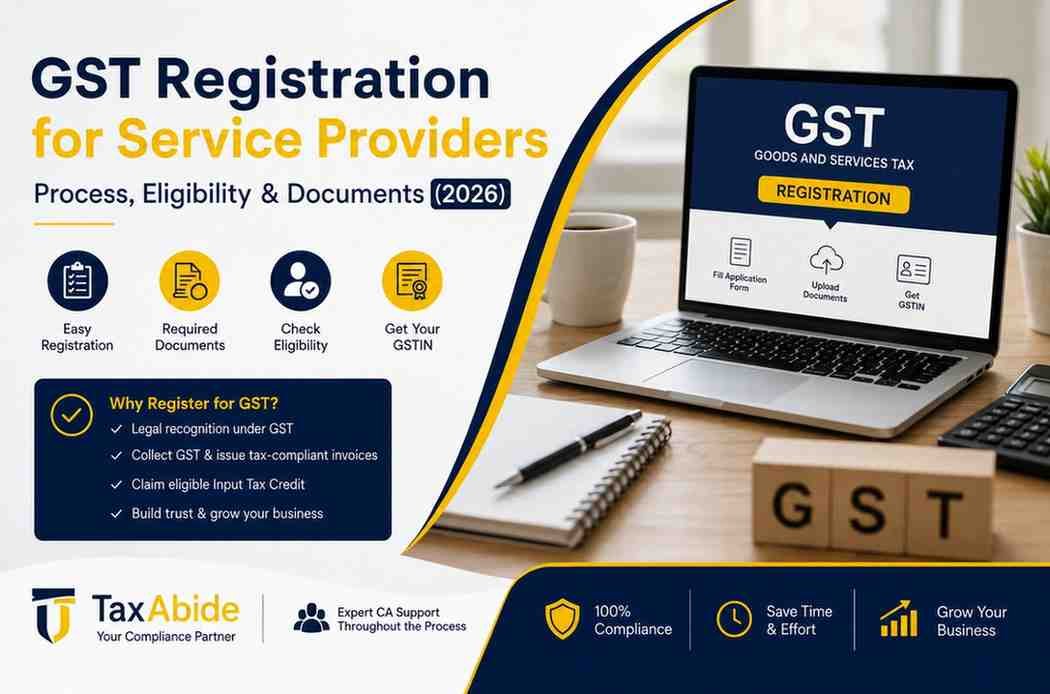
GST Registration for Service Providers in India: Process, Eligibility & Documents (2026)
Running a service business in India comes with its own set of challenges. Apart from catering to the demands of your clients, one also needs to be aware of the rules and regulations of the government and the necessary tax compliances. GST Registration for Service Providers is one such compliance that cannot be ignored if the turnover of one’s business exceeds a certain threshold limit or falls under one of the specified categories.
Whether you are a Consultant, freelancer, Digital Marketer, software developer, Architect, Lawyer, or a service provider of any other domain, here’s a guide that will keep you updated on everything related to tax compliance and the GST registration process in India, including the eligibility criteria and documents required to register your business under GST.
Therefore, if you are looking for expert guidance with GST Registration for Service Providers, you can rely on TaxAbide. Learn more about our expertise on our About Us page, where you'll discover how we help businesses across India with GST registration, tax compliance, and company registration services.
Quick Answer
If you are providing any taxable service in India and your turnover from such services crosses the threshold limit of GST, you will be mandated to get a GST registration for service providers. By registering yourself, you can collect GST in a legal manner, claim input tax credit, and adhere to the GST guidelines. In addition, if you are not liable to get registered, you might consider it from a business perspective.
Key Takeaways
GST Registration is mandatory for many service providers based on turnover and specific business situations.
A valid GSTIN improves your business credibility.
Registered businesses can claim eligible Input Tax Credit.
Proper GST compliance helps avoid penalties and legal issues.
Professional assistance can make the registration process faster and error-free.
AI Overview Answer
What Is GST Registration for Service Providers?
GST Registration for Service Providers refers to the procedure under which a proprietorship having services as its business offers GST registration. The registration process helps a proprietorship firm to collect tax from the customers, claim eligible input tax credit, file tax returns, and pay taxes online. Upon successful registration, one gets a Goods and Services Tax Identification Number.
The registration process has to be accomplished online on the GST portal by submitting the relevant documents that help the GST authorities take a decision on the application.
GST Registration for Service Providers
Whether you are an independent professional or a big business owner, GST compliance is crucial to ensure that your business operates legally.
Most people think that GST registration is mandatory only for businesses at a certain scale, which is incorrect. Some specific professionals are mandated by law to register irrespective of their turnover, while some others get mandated when their turnover crosses a certain threshold.
Obtaining GST Registration for Service Providers offers several benefits beyond legal compliance.
These include:
Legal recognition under the GST system.
Ability to issue GST-compliant tax invoices.
Eligibility to claim Input Tax Credit on business purchases.
Increased trust among clients and corporate customers.
Better opportunities to work with larger businesses and government organizations.
Improved financial transparency.
As businesses grow, having a GST registration also simplifies taxation and accounting processes.
Who Needs GST Registration for Service Providers?
Not every service provider is required to register immediately. However, registration becomes mandatory in specific situations.
Generally, GST registration applies to:
Business consultants.
Chartered Accountants.
Lawyers.
Architects.
Interior designers.
Digital marketing agencies.
IT companies.
Software developers.
Freelancers.
Advertising agencies.
Event management companies.
Online service providers.
Professional service firms.
Even if your turnover is below the threshold, voluntary registration may still benefit businesses that deal with corporate clients or want to claim Input Tax Credit.
Benefits of GST Registration for Service Providers
Why More Businesses Are Registering Under GST
According to government data, GST has significantly expanded India's indirect tax system by bringing millions of businesses under a unified tax framework. Today, GST registration is not just about paying taxes. It also improves transparency, simplifies compliance, and supports business growth.
For many service providers, GST registration has become an important step toward building a professional and trustworthy business.
Expert Tip
If you expect your business to grow beyond the GST threshold in the near future, consider planning your registration. Early preparation helps avoid last-minute compliance issues and allows you to start issuing GST-compliant invoices without interruption.
What You Will Learn Next
In the next section, we will explain the GST Registration Process, eligibility criteria, turnover limits, required documents, and the step-by-step online application process. We will also discuss common mistakes that service providers should avoid during registration.
GST Registration Eligibility for Service Providers
Understanding the eligibility criteria is the first step before applying for GST Registration for Service Providers. Many business owners assume GST registration is required only after reaching a certain turnover. While turnover is important, some businesses must register regardless of their annual revenue.
Therefore, checking your eligibility before starting the registration process can save both time and unnecessary penalties.
Who Is Eligible for GST Registration?
A service provider generally needs GST Registration for Service Providers if they fall under any of the following categories:
Annual turnover exceeds the prescribed GST threshold.
Services are provided across different states where registration is applicable.
Business sells services through an e-commerce platform in cases where GST law requires registration.
Business is liable under compulsory registration provisions.
Voluntary registration is chosen to claim Input Tax Credit or improve business credibility.
Even if your business is small, voluntary registration may help you work with larger clients who prefer GST-registered vendors.
GST Threshold Limit for Service Providers
The GST threshold depends on the type and location of your business.
Since GST rules may change over time, always verify the latest threshold limits before applying.
GST Registration Documents Required
Preparing the correct GST Registration Documents helps ensure a smooth approval process. Missing or incorrect documents can delay your application.
Commonly required documents include:
PAN Card of the applicant or business.
Aadhaar Card.
Passport-size photograph.
Business address proof.
Identity proof of promoters or partners.
Bank account details.
Proof of business registration, where applicable.
Digital Signature Certificate for entities that require digital signing.
Before uploading your documents, ensure all details match your official records.
GST Registration Process Step by Step
The GST Registration Process is completed online through the official GST Portal. Although the application is digital, each step should be completed carefully.
Step 1: Visit the GST Portal
Go to the official GST Portal and choose the option to register a new taxpayer.
Step 2: Enter Basic Business Details
Provide your PAN, mobile number, email address, and basic business information.
Step 3: Verify OTP
You will receive verification codes on your registered mobile number and email address.
Step 4: Complete the Application
Fill in your business details, promoter information, principal place of business, and bank account information.
Step 5: Upload GST Registration Documents
Upload all required documents in the prescribed format.
Step 6: Submit the Application
After reviewing all details, submit the application using the appropriate verification method.
Step 7: Receive GST Registration Certificate
Once the application is approved, your business receives a GSTIN along with the GST Registration Certificate.
Common Mistakes During GST Registration
Many applications are delayed because of simple mistakes.
Avoid these common errors:
Entering incorrect PAN details.
Uploading unclear documents.
Using an incorrect business address.
Selecting the wrong business activity.
Providing incorrect bank information.
Skipping mandatory fields in the application.
Review every detail before submitting your application to avoid unnecessary delays.
Why Online GST Registration Is Becoming Popular
Today, businesses prefer Online GST Registration because it is faster, paperless, and more convenient than traditional processes.
Some key advantages include:
Faster application process.
Easy document upload.
Digital verification.
Online application tracking.
Reduced paperwork.
Convenient access from anywhere.
Many businesses also choose professional GST Registration Services to minimise errors and complete the application correctly on the first attempt.
Expert Tip
If you are unsure whether your business requires GST registration, seek professional advice before making a decision. Registering too late may lead to compliance issues, while registering at the right time can improve your business credibility and simplify future tax filings.
What You Will Learn Next
In the final section, you will discover the major benefits of GST Registration for Service Providers, common compliance mistakes after registration, answers to frequently asked questions, and why professional Online CA Services in India can help your business stay fully GST compliant.
Benefits of GST Registration for Service Providers
Many business owners see GST registration as only a legal requirement. However, it offers several practical advantages that can support long-term business growth. A valid GST Registration for Service Providers not only helps you comply with tax laws but also builds trust with clients and improves financial management.
Some of the major benefits include:
Legal recognition for your business.
Ability to issue GST-compliant tax invoices.
Eligibility to claim Input Tax Credit on eligible purchases.
Better business credibility with clients.
Improved opportunities to work with corporate organisations.
Easier access to government and large business contracts.
Better financial transparency.
Smooth GST return filing and compliance.
For growing businesses, these advantages often outweigh the effort required to complete the registration process.
GST Registration for Service Providers vs Voluntary Registration
Some service providers are legally required to register under GST, while others choose voluntary registration based on their business needs.
If you frequently work with companies that prefer GST-registered vendors, voluntary registration can strengthen your professional image.
Common GST Compliance Mistakes to Avoid
Obtaining GST registration is only the beginning. After registration, businesses must continue meeting their compliance responsibilities.
Common mistakes include:
Delaying GST return filing.
Incorrect GST invoice preparation.
Claiming ineligible Input Tax Credit.
Not updating business information when changes occur.
Maintaining incomplete financial records.
Ignoring GST notices from tax authorities.
Following proper GST Compliance practices helps reduce the risk of penalties and ensures your business remains legally compliant.
Why Choose Professional GST Registration Services?
Although the registration process is online, many applications are delayed because of incorrect information or missing documents.
Professional GST Registration Services can help you:
Verify your eligibility.
Prepare accurate documentation.
Complete the application correctly.
Reduce processing delays.
Receive expert guidance on GST compliance.
Understand future filing responsibilities.
Working with experienced professionals also helps you avoid common registration errors that may affect your business later.
Why Choose TaxAbide?
At TaxAbide, we provide reliable Online CA Services in India for startups, freelancers, consultants, and businesses of every size. Our experienced professionals assist with GST Registration for Service Providers, tax planning, accounting, company registration, and ongoing compliance support.
Our services include:
GST Registration.
GST Return Filing.
Company Registration.
Income Tax Filing.
Business Compliance Services.
Accounting and Bookkeeping Services.
Tax Planning and Advisory.
Whether you are starting a new business or expanding your existing services, our experts help simplify the registration process while ensuring complete compliance.
Conclusion
Understanding GST Registration for Service Providers is essential for anyone offering professional or commercial services in India. It helps your business comply with tax regulations, improves credibility, enables eligible Input Tax Credit claims, and supports long-term business growth.
Before applying, ensure you understand the GST Registration Eligibility, prepare the required GST Registration Documents, and follow the correct GST Registration Process. Taking the right approach from the beginning can save time and help you avoid unnecessary compliance issues.
If you need expert guidance, TaxAbide offers trusted Online CA Services in India, helping businesses with GST registration, tax planning, accounting, and Business Compliance Services. If you have questions or need personalized assistance, visit our Contact Us page to connect with our experts. Our experienced professionals are committed to making the registration process simple, accurate, and hassle-free.
Related Blogs
Frequently Asked Questions
PAN Card.
Aadhaar Card.
Business address proof.
Bank account details.
Photograph.
Business registration proof, where applicable.
Additional documents may be required depending on your business structure.