
ITR-6 AY 2026-27: Who Needs to File, Due Date, Documents & Filing Process
Published: August 21, 2026
Last Updated: August 21, 2026
If your company needs to file an income tax return for AY 2026-27, choosing the correct ITR form is important. ITR-6 AY 2026-27 is the return form applicable to companies that are not claiming exemption under Section 11.
The Income Tax Department has now made ITR-6 available for AY 2026-27 through both online and offline utilities. The online utility became available on August 18, 2026, while the offline utility was released on August 20, 2026.
This guide explains who needs to file ITR-6, the applicable due date, documents required, online filing process, ITR-6 eligibility, and common mistakes companies should avoid.
Quick Answer
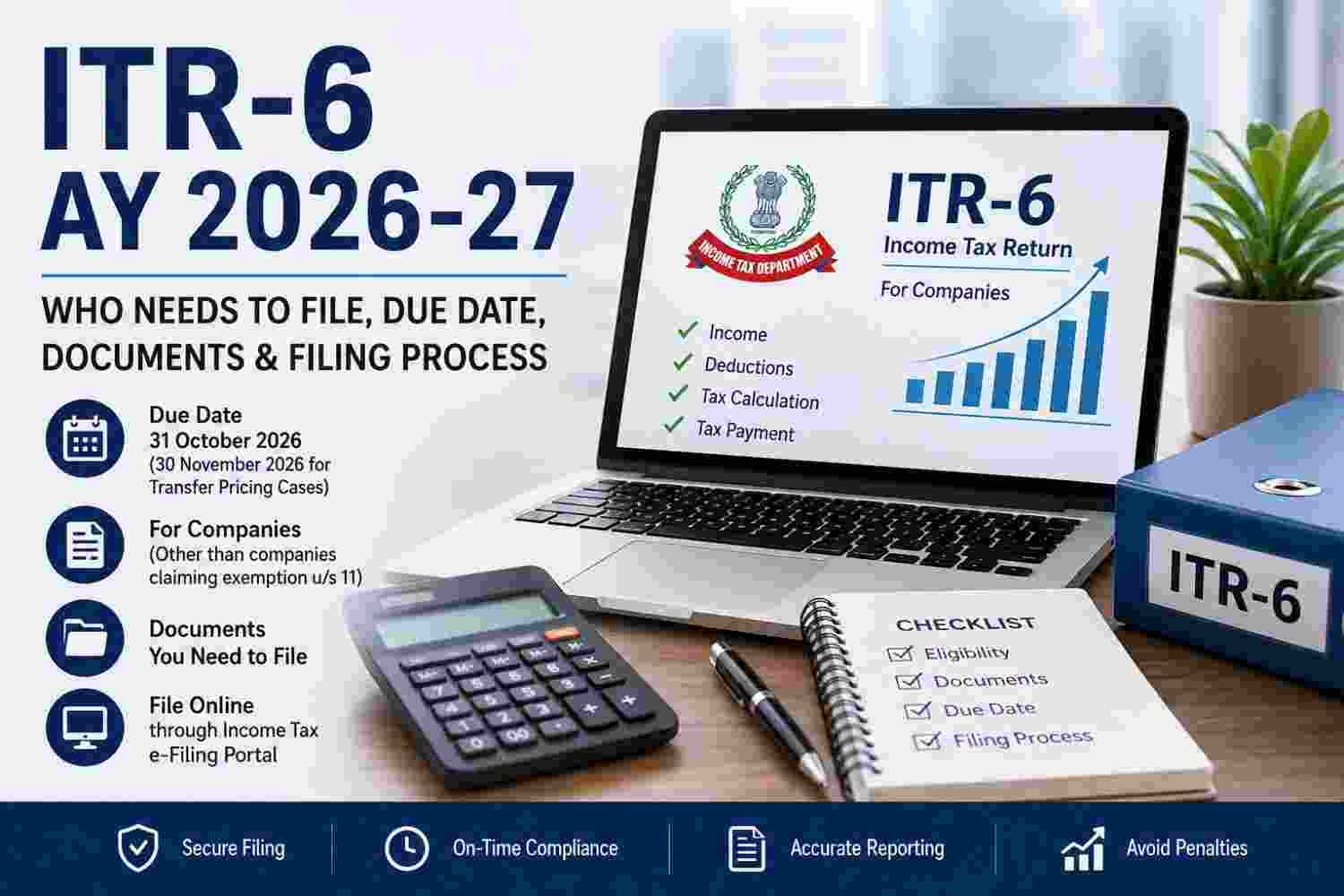
ITR-6 is applicable to companies other than companies claiming exemption under Section 11. For AY 2026-27, companies can file ITR-6 through the Income Tax e-Filing portal using the available online or offline utility. The normal company return due date is generally October 31, 2026, while certain transfer-pricing cases have a November 30, 2026 due date.
Key Takeaways
ITR-6 is primarily for companies that do not claim exemption under Section 11.
ITR-6 AY 2026-27 relates to FY 2025-26.
Online ITR-6 filing became available on August 18, 2026.
The offline utility became available on August 20, 2026.
Companies generally need to file their return electronically.
The return must be verified using the prescribed verification method, including DSC where applicable.
The tax audit report has a separate filing requirement and deadline where tax audit provisions apply.
Companies should check the latest validation rules before submitting the return.
What Is ITR-6?
ITR-6 is an Income Tax Return form used by companies that are not claiming exemption under Section 11 of the Income Tax Act, 1961.
It is designed for companies to report their income, deductions, tax liability, and other required information to the Income Tax Department.
For AY 2026-27, ITR-6 relates to income earned during FY 2025-26. According to the Income Tax Department, the return for income earned during FY 2025-26 is filed for AY 2026-27 under the Income Tax Act, 1961, even though filing generally takes place after April 1, 2026.
Income Tax Department – Income Tax Returns
Who Is This ITR-6 Guide For?
This guide is for private limited companies, public companies, One Person Companies and other eligible
companies preparing their income tax return for AY 2026-27. It is especially useful for company directors, finance teams, accountants and business owners who need to understand ITR-6 eligibility, due dates, required documents and the filing process.
Who Needs to File ITR-6 for AY 2026-27?
A company generally needs to file ITR-6 AY 2026-27 if it is required to furnish an income tax return and is not claiming exemption under Section 11.
This can include companies such as:
Private limited companies
Public limited companies
One Person Companies
Other companies covered by the applicable income-tax provisions
The key point is that company status alone is not enough to decide the form. The exemption claimed and the applicable provisions also need to be considered.
The Income Tax Department's guidance specifically identifies ITR-6 for companies other than companies claiming exemption under Section 11.
Who Does Not Need ITR-6?
A company claiming exemption under Section 11 generally does not use ITR-6.
Such entities may need to examine whether ITR-7 is applicable instead.
Therefore, before filing, check:
Company status → exemption claimed → applicable ITR form
Do not select ITR-6 simply because the taxpayer is a company.
What Is the ITR-6 Due Date for AY 2026-27?
For a company whose return is not covered by the transfer-pricing extended deadline, the normal due date is generally:
October 31, 2026
Where the company is required to furnish a report under Section 92E, the applicable ITR due date is generally:
November 30, 2026
The Income Tax Department's current guidance also identifies October 31 and November 30 as the relevant company-return dates depending on the applicable case.
Important
The tax audit report has a separate deadline.
For AY 2026-27, where the ITR due date is October 31, the tax audit report is generally due one month earlier, i.e., September 30, 2026. For transfer-pricing cases with a November 30 ITR deadline, the audit-report deadline is generally October 31, 2026.
What Documents Are Required for ITR-6 Filing?
The exact documents depend on the company's activities and financial position. However, companies should generally keep the following information ready:
PAN and company details
Financial statements
Profit and Loss Account
Balance Sheet
Books of accounts
Bank statements
Details of income and expenses
TDS/TCS information
Advance tax and self-assessment tax details
Details of deductions and allowances
Tax audit report, where applicable
Form 3CEB, where applicable
Details of foreign transactions, where applicable
Details of shareholders and related transactions where required
Not every company will need every document. The correct checklist depends on the company's transactions and reporting requirements.
Is ITR-6 Filing Mandatory Online?
Yes. Company income tax returns are required to be furnished electronically in the prescribed manner.
For AY 2026-27, the Income Tax Department has made ITR-6 available through online and offline utilities.
The offline route involves preparing the return using the utility and uploading the generated JSON through the e-Filing portal. The Income Tax Department's offline utility guidance explains this process for ITR-5 to ITR-7.
How to File ITR-6 Online for AY 2026-27?
The basic ITR-6 filing process for Companies is:
Step 1: Log in to the e-Filing Portal
Visit the official Income Tax e-Filing portal and log in using the company's credentials.
Step 2: Select Income Tax Return
Go to:
e-File → Income Tax Returns → File Income Tax Return
Select the relevant AY 2026-27.
Step 3: Select ITR-6
Choose ITR-6 as the applicable return form.
Before continuing, verify that the company is eligible to use ITR-6.
Step 4: Select Filing Mode
Choose the available filing method:
Online
Offline utility
Both options are currently available for ITR-6 AY 2026-27.
Step 5: Enter or Import Information
Provide the required details relating to:
Company profile
Income
Expenses
Assets and liabilities
Tax deductions
TDS/TCS
Tax payments
Audit information
Other applicable schedules
Step 6: Validate the Return
Before submission, review the return carefully.
The Income Tax Department has published ITR-6 validation rules for AY 2026-27, which are designed to identify data-quality issues and errors during filing.
Step 7: Submit and Verify
After reviewing the return, submit it through the prescribed process and complete verification using the applicable method.
For companies, the prescribed digital-signature requirements should be followed.
What Is the Difference Between ITR-6 and ITR-7?
The main distinction is based on the type of entity and exemption being claimed.
The correct form should always be determined from the taxpayer's actual circumstances rather than simply choosing the form used by another company.
ITR-6 AY 2026-27 and Tax Year 2026-27: Are They the Same?
No.
This is an important point for 2026.
ITR-6 AY 2026-27 relates to FY 2025-26, and the Income Tax Department confirms that this return continues under the Income Tax Act, 1961.
The new Tax Year framework applies to income periods beginning under the new Act.
So:
FY 2025-26 → AY 2026-27 → ITR-6 under the old Act, where applicable
This distinction is particularly important because the new Income Tax Act, 2025 started applying from April 1, 2026.
What Is the Latest ITR-6 Utility for 2026?
The Income Tax Department has released the ITR-6 utilities in stages.
August 4, 2026: Excel utility became available.
August 18, 2026: Online ITR-6 filing became available.
August 20, 2026: Offline ITR-6 utility became available.
Therefore, companies preparing their AY 2026-27 return should use the latest version available on the official e-Filing portal rather than relying on an older downloaded utility.
What Are Common ITR-6 Filing Mistakes?
Companies should be careful about these common issues:
Selecting ITR-6 without checking eligibility.
Confusing AY 2026-27 with Tax Year 2026-27.
Using an outdated utility.
Entering financial statement figures incorrectly.
Failing to reconcile TDS/TCS information.
Missing applicable audit information.
Ignoring validation errors.
Failing to complete verification after submission.
Because the Department's validation rules are specifically designed to detect data-quality issues, companies should review validation messages before final submission.
Why Should Companies Take ITR-6 Filing Seriously?
Company returns involve considerably more information than many individual returns. Financial statements, tax audit information, TDS/TCS, related transactions, and other schedules may need to be reported correctly.
A small reporting error can therefore create additional compliance work later.
For this reason, companies should reconcile their financial and tax records before submitting the return.
How Can Professional ITR Filing Services Help?
Companies dealing with complex financial transactions may benefit from professional assistance.
Income Tax Return Filing Services can help businesses with:
ITR form selection
Return preparation
Tax computation
TDS/TCS reconciliation
Tax audit coordination
Documentation
Filing and verification
Identifying potential filing errors
Professional support can be particularly useful for companies with multiple sources of income, tax audit requirements, or transfer-pricing transactions.
Final Takeaway
ITR-6 AY 2026-27 is the relevant income tax return for eligible companies that are not claiming exemption under Section 11. The online utility is currently available, and the offline utility is also available through the Income Tax Department's e-Filing system.
Before filing, check the company's eligibility, applicable due date, required documents, audit requirements, and latest utility version.
For companies that need help with Income Tax Return Filing Services, professional tax assistance can make the filing process easier and help reduce avoidable errors.
For TaxAbide's professional tax support, visit About Us or Contact Us for assistance.
Latest Blogs
You may also find these articles helpful: